
Men’s Mental Health: Signs, Struggles & How to Break the Silence

Men’s mental health is shaped long before anyone ever names it. It is handed down quietly — in the way a father doesn’t cry at funerals, in the way a teenage boy is told to “shake it off,” in the way a grown man sits with something heavy inside his chest for years and simply calls it “just life.”
Men’s mental health is one of the most urgent, underrepresented conversations of our time. And yet, so many men are still carrying things alone that were never meant to be carried alone. If you are one of them — or if you love someone who is — this article is for you. Not as a clinical breakdown of statistics, but as an honest, human conversation about what it really feels like to be a man struggling in silence, and what it looks like to finally start letting that silence break.
Table of Contents
Why Men Struggle in Silence: The Weight of “Man Up”
Think about the last time a man in your life cried in front of others. Or admitted he was overwhelmed. Or said, “I’m not okay.”
For most people, that memory is either very rare or completely absent.
Men are taught — not always in words, but in a thousand small moments — that emotional expression is weakness. That needing help is a burden. That real strength means never letting anyone see you struggle.
This cultural conditioning has a name: it is called masculine stoicism, and it is quietly devastating men’s mental health around the world.
Take Marcus, 34, a project manager from Chicago. He describes working 60-hour weeks, managing a difficult divorce, and spending evenings alone in an apartment that felt like it was slowly swallowing him. “I told everyone I was fine,” he says. “I was promoted twice that year. Nobody would have guessed.”
Or James, a 28-year-old from Atlanta, who grew up watching his father handle every crisis without flinching. “I thought feeling sad or scared meant I was failing at being a man. So I just… pushed it down. For years.”
These are not extreme stories. They are ordinary ones. And they are happening everywhere.
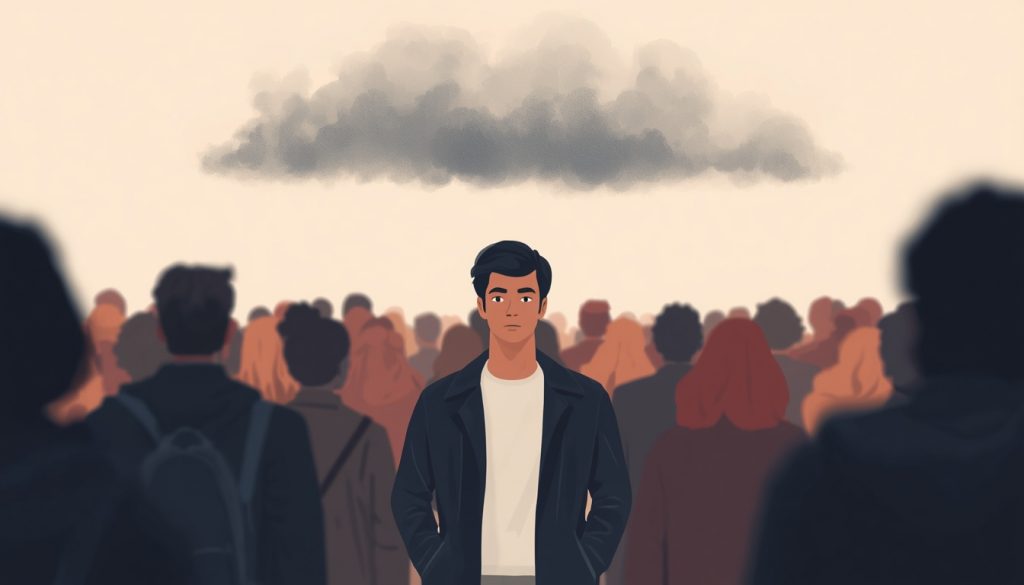
Men’s Mental Health Statistics: The Numbers That Are Hard to Ignore
The numbers, when you sit with them, are hard to ignore.
According to the American Foundation for Suicide Prevention, men die by suicide at nearly four times the rate of women in the United States. Yet men are significantly less likely to seek mental health treatment, less likely to be diagnosed with depression or anxiety, and far less likely to talk to someone about what they are going through.
The National Institute of Mental Health notes that depression in men often presents differently than it does in women — showing up as irritability, anger, reckless behavior, substance use, or physical symptoms like chronic pain and exhaustion, rather than the sadness and crying that are more commonly associated with depression.
This difference matters enormously. If men don’t recognize what they are feeling as depression or anxiety, they won’t seek help for it. And if the people around them don’t recognize it either, they won’t offer it.
The World Health Organization estimates that over 450 million people worldwide are currently living with a mental health condition — and that the treatment gap is widest among men, particularly in communities where traditional masculine norms are strongest.
The silence is not neutral. It is costing lives.
Signs of Poor Mental Health in Men: What It Actually Looks Like
Men’s mental health struggles don’t always look like someone sitting in a darkened room unable to get up. Sometimes they look like this:
Anger That Doesn’t Make Sense
David, 41, a teacher from Ohio, describes months where he would come home from work and find himself snapping at his kids over nothing. The smallest inconveniences sent him into a rage he couldn’t explain. “I thought I was just stressed,” he says. “It took me a year to realize I was depressed.”
If you’re not sure what depression actually looks like, the National Institute of Mental Health has a clear, jargon-free breakdown worth reading.
Anger is one of the most common ways depression and anxiety present in men. When the full range of emotions has been suppressed, what’s left often comes out as irritability and frustration.
Disappearing Into Work
Jake, 37, a software engineer, describes spending 12 to 14 hours a day at his desk not because he loved his job, but because being busy meant he didn’t have to feel. “Work was safe. Work made sense. My own head did not.”
Workaholism as avoidance tends to escalate gradually, and because it looks like productivity, the people closest to you may not raise concern until it has gone on for years. If this resonates, the audit in Step 4 below is worth sitting with.
Overworking is a common coping mechanism for men avoiding painful emotions — and because it looks productive, it can go unnoticed for years.
Substance Use as a Pressure Valve
The Substance Abuse and Mental Health Services Administration (SAMHSA) reports that men are significantly more likely than women to use alcohol and drugs as a way of managing stress, anxiety, and depression. A few drinks to take the edge off slowly becomes something harder to put down.
For many men, substance use is the first sign that something underneath needs attention — long before they would ever describe themselves as “struggling with their mental health.”
Physical Symptoms With No Clear Cause
Chronic headaches. Unexplained back pain. A persistent heaviness in the chest. The body keeps score even when the mind is not ready to speak.
Research consistently shows that men are more likely to report mental health struggles in physical terms — visiting a doctor for fatigue or pain rather than acknowledging the emotional roots beneath it.
The Identity Piece: What Masculinity Has to Do With It
Men’s mental health and masculine identity are deeply intertwined in ways that are difficult to separate.
The message that vulnerability is weakness does not come from nowhere. It is passed down through generations, reinforced by media, by sports culture, by workplaces, by family systems. Boys learn very early that the way to be respected, loved, and seen as capable is to not need things.
And here is what makes it so complicated: many men genuinely believe this to their core. It is not cynical performance. It is something they were taught and something they have lived. Asking them to simply “open up” without addressing the deeper story they carry about what that means is not enough.
This is why exploring the connection between gender norms and mental health is so important. At Mindbloom, we’ve written about how gender norms shape mental health in ways most of us have never examined — and if you’ve ever been told to “man up” or “stop being so sensitive,” that piece will likely hit close to home.
The work of men’s mental health is not just about coping strategies. It is about permission. It is about finally allowing yourself to be a full human being, with needs, with pain, with complexity — and realizing that this does not make you less of a man. It makes you more of a person.
What Happens When Men Don’t Get Help
Let’s be honest about what the silence actually costs.
When men consistently suppress emotional pain without any outlet, the consequences compound over time. Relationships suffer. Substance use can escalate. Physical health deteriorates. Isolation deepens. And in the most painful cases, the weight becomes unbearable.
Men who struggle in silence are also less able to show up for the people who depend on them. The father who never learned to name his feelings raises children who never learn to name theirs. The cycle continues.
It is also worth noting that men who are struggling often push away the people who love them most. Not because they don’t want connection, but because asking for it feels terrifying. Understanding this can help partners, family members, and friends respond with patience rather than frustration.
If you have ever watched someone you love disappear into silence, understanding how adversity builds strength through the process of growth and healing may offer some grounding — both for you and for them.
How to Improve Men’s Mental Health: What Actually Helps
The good news is that men’s mental health can improve. And improving it does not require becoming someone you are not.
Here are practical, honest steps that can make a real difference:
1. Name What You Are Feeling — Even Privately First
You don’t have to tell anyone anything right away. Start by getting honest with yourself. Keep a notes file on your phone, write in a journal, or just sit quietly and ask yourself: what is actually going on under the surface?
Naming an emotion does not make you weak. It makes you aware. And awareness is where everything starts.
2. Find One Person You Trust
You don’t need to post about your feelings publicly or become an open book overnight. Start with one person. A friend, a sibling, a partner, a mentor. Tell them one true thing about how you’re doing.
The first time is the hardest. It almost always gets a little easier after that.
3. Move Your Body
Exercise is not just physical maintenance. It is one of the most well-researched tools for emotional regulation available to us. Running, lifting, swimming, hiking — movement shifts something in the body and the mind that nothing else quite replicates.
Many men find that talking while moving — a walk with a friend rather than a sit-down conversation — feels more accessible. Use that.
4. Audit the Coping Mechanisms You Are Already Using
Alcohol. Overworking. Isolation. Scrolling. These are not character flaws — they are things humans do when they are in pain and don’t know what else to do.
But it is worth asking: is what I’m doing helping me heal, or is it helping me avoid? That distinction matters.
5. Consider Therapy — and Reframe What It Means
Therapy is not for people who are broken. It is for people who are serious about understanding themselves.
Some men find that they respond particularly well to more structured, solution-focused approaches. Acceptance and Commitment Therapy, for example, has shown strong results for men who have historically struggled with more traditional talk therapy. You can read more about how Acceptance and Commitment Therapy works and whether it might be right for you — and it may reframe what therapy even looks like.
6. Let Yourself Receive Care
This one is often the hardest. Accepting help from others — a meal, a check-in, a shoulder — requires tolerating the feeling of needing something. For many men, that feeling is more uncomfortable than the pain itself.
Practice receiving. It is a skill, not a given, and it can be built.
7. Connect With Others Who Get It
There is something uniquely powerful about being in a room — physical or virtual — with other men who are also figuring this out. Men’s support groups, community organizations, online forums for mental wellness, and even podcasts that speak honestly about men’s experiences can all reduce the isolation that makes mental health struggles so much harder.

For the People Who Love Men Who Are Struggling
If you are reading this because someone in your life is silent in a way that worries you, this section is for you.
Pushing someone to talk before they are ready rarely works. But showing up consistently, without condition, does more than you might think. Let them know you’re not going anywhere. Express care without making it feel like a performance review.
Avoid telling a man that he “should” be feeling better, or “should” go to therapy. The word “should” tends to land as judgment, not support. Instead, try: “I’ve noticed you seem tired lately. I just want you to know I’m here.”
Small, consistent presence matters more than grand gestures of concern.
And if you are going through your own weight while supporting someone else, please make sure you are also tending to your own wellbeing. Learning to build resilience for yourself matters here too — you cannot pour from empty.
A Word on Seeking Professional Help
If you are at a point where the weight feels unmanageable, please do not wait to reach out to a professional.
Therapy works. Medication, when appropriate, works. These are not signs of failure — they are tools, the same way a cast is a tool for a broken bone.
In the US, you can find a therapist through Psychology Today’s therapist finder, which allows you to filter by specialty, insurance, and even therapist identity if that matters to you.
The 988 Suicide and Crisis Lifeline is available around the clock, by call or text, if you or someone you love is in crisis.
You deserve support. Needing it is not the same as failing.
Men’s Mental Health Is Not a Weakness — It Is the Frontier
There is a quiet shift happening.
Men are beginning to talk about therapy in the same casual way they talk about going to the gym. Public figures are being honest about their struggles in ways that would have been unthinkable a generation ago. The definition of strength is slowly, meaningfully widening.
You don’t have to wait for the culture to fully catch up. You can start now, inside your own life, with the smallest act of honesty.
One true sentence to yourself. One conversation with someone you trust. One morning where you sit with what you’re feeling instead of running from it.
Men’s mental health is not a weakness to be ashamed of. It is a frontier to be explored — with the same courage that you bring to everything else in your life. The silence can break. You get to decide when.
Frequently Asked Questions
1. Why don’t men talk about their mental health? Men don’t talk about their mental health primarily because they’ve been socialized to see emotional expression as weakness. From childhood, cultural norms around masculinity teach boys that needing help is a burden — and that showing feelings makes them less capable or less respected. This conditioning, reinforced across families, media, and workplaces, creates a deep reluctance to acknowledge inner struggle. It is not that men don’t feel — it is that they have been taught, in many subtle ways, that feeling should not be shown.
2. What are the signs of depression in men? The most common signs of depression in men include irritability and anger, withdrawal from relationships, increased alcohol or drug use, reckless behavior, and loss of interest in hobbies. Men also frequently experience physical symptoms like chronic pain or fatigue, and many use overworking as a way to avoid difficult emotions. Male depression often goes undiagnosed precisely because these symptoms don’t match the typical image of sadness or tearfulness most people associate with depression.
3. How common is mental illness in men? Mental illness is very common in men, though it is underreported and underdiagnosed. In the United States, millions of men live with depression, anxiety, PTSD, and other mental health conditions every year. Men also account for the majority of suicide deaths — nearly four times the rate of women according to the American Foundation for Suicide Prevention. The gap between the number of men who struggle and those who seek help is significant.
4. Why do men have higher suicide rates? Men tend to use more lethal methods in suicide attempts, receive less social support during crisis, and are far less likely to have talked to anyone about how they were feeling before reaching a breaking point. The stigma around men asking for help means that many suffer in silence until the pain becomes unbearable. This is why early, ongoing conversations about men’s mental health can be genuinely life-saving.
5. How can I help a man who is struggling but won’t talk? The most important thing is consistent, low-pressure presence. Rather than pushing him to open up or telling him he needs help, let him know you’re there without making it conditional. Show up, keep showing up, and make it easy for him to talk when he’s ready. Avoid framing his silence as a problem he needs to fix. Sometimes doing something together — a walk, a shared activity — creates more space for conversation than sitting down and asking “how are you feeling?”
6. What is the best type of therapy for men? There is no single best therapy for men, but some approaches tend to resonate more with men who are skeptical of traditional talk therapy. Cognitive Behavioral Therapy (CBT) and Acceptance and Commitment Therapy (ACT) are goal-oriented, practical approaches that many men find helpful. Group therapy or men-specific support groups can also be powerful, as they reduce the isolation of struggling alone.
7. Can men’s mental health improve without professional help? Some men do make meaningful progress through lifestyle changes, social support, exercise, community, and honest self-reflection. However, when mental health struggles are significantly affecting daily life, relationships, or safety, professional support is strongly recommended. Therapy and/or medication can make a real difference and are not a sign of weakness.
8. Does mental health in men affect their relationships? Deeply, yes. Unaddressed mental health struggles can show up in relationships as emotional unavailability, frequent anger or irritability, withdrawal, substance use, difficulty communicating needs, and patterns of self-sabotage. When men get support and begin to process what they carry, the quality of their relationships often improves significantly. It is not just something men do for themselves — it benefits everyone around them.
9. How does social media affect men’s mental health? Social media presents curated versions of success, physicality, and invulnerability that can intensify the pressure men already feel to appear strong and accomplished. Constant comparison, reduced real-world connection, and exposure to hyper-masculine content can all deepen feelings of inadequacy and isolation. Taking intentional breaks from social media and investing in in-person relationships is genuinely beneficial for men’s wellbeing.
10. When should a man seek professional mental health support? Any time the weight feels like more than he can manage alone — that is reason enough. More specifically: if emotions are interfering with work or relationships, if coping mechanisms are becoming harmful, if there is persistent hopelessness or numbness, if thoughts of self-harm are present, or if it has simply been a very long time since he has felt like himself. Seeking help early, before crisis, is always better than waiting.
A Personal Question for You
What’s one thing you wish someone had told you — or told the men in your life — about asking for help? Drop it in the comments below. You don’t need to write much. Even one sentence matters here.
Disclaimer
This article is written from lived experience and for general informational and supportive purposes only. It is not a substitute for professional mental health treatment, diagnosis, or advice. If you or someone you know is in crisis, please contact the 988 Suicide and Crisis Lifeline by calling or texting 988, or visit your nearest emergency service. Mindbloom is a personal blog, not a clinical resource.