
Acceptance and Commitment Therapy (ACT): What It Is, How It Works, and Whether It’s Right for You

Have you ever spent years trying to think your way out of pain — only to find it still waiting for you every single morning? Acceptance and Commitment Therapy (ACT) exists precisely for moments like that. You’ve tried positive thinking. You’ve tried pushing the feelings down. You’ve tried being “stronger.” And still, the anxiety shows up. The sadness lingers. The thoughts spiral. If that sounds like you, ACT might be the thing nobody has told you about yet — and it could change the way you relate to your own mind forever.
ACT (pronounced like the word “act,” not as initials) is not about fixing your thoughts or eliminating hard feelings. Many people search for “ACT therapy” and “what is ACT” — the shorthand used by therapists and researchers worldwide for this approach. It’s about learning to carry them differently — and living a full, meaningful life anyway. In a world that tells us we should always feel good, ACT quietly says something far more powerful: You don’t have to feel good to live well.
This guide will walk you through everything you need to know about Acceptance and Commitment Therapy in a way that actually makes sense — no textbooks, no clinical jargon. Just honest, warm, and practical words written for real people who are tired of struggling against themselves.
Table of Contents
What Is Acceptance and Commitment Therapy (ACT)?
Acceptance and Commitment Therapy is a form of psychotherapy developed in the 1980s by psychologist Steven C. Hayes. It grew out of traditional cognitive behavioral therapy but took a bold turn: instead of trying to change or challenge your negative thoughts, ACT teaches you to change your relationship with those thoughts.
The core idea is surprisingly simple. Psychological suffering doesn’t usually come from the difficult thoughts and feelings themselves. It comes from the constant battle we wage against them. We resist, avoid, suppress, and argue with our inner world — and that struggle is what keeps us stuck.
ACT is built on the belief that you can acknowledge pain, make room for it, and still move toward what matters most to you. It works through three broad areas:
- Accept what you cannot control (your thoughts, feelings, memories, and physical sensations)
- Choose a direction guided by your personal values
- Take action that moves you toward the life you actually want
It sounds almost too simple. But the practice of it? That’s where the real work — and the real freedom — lives.
The Six Core Processes of ACT (And Why They Matter)
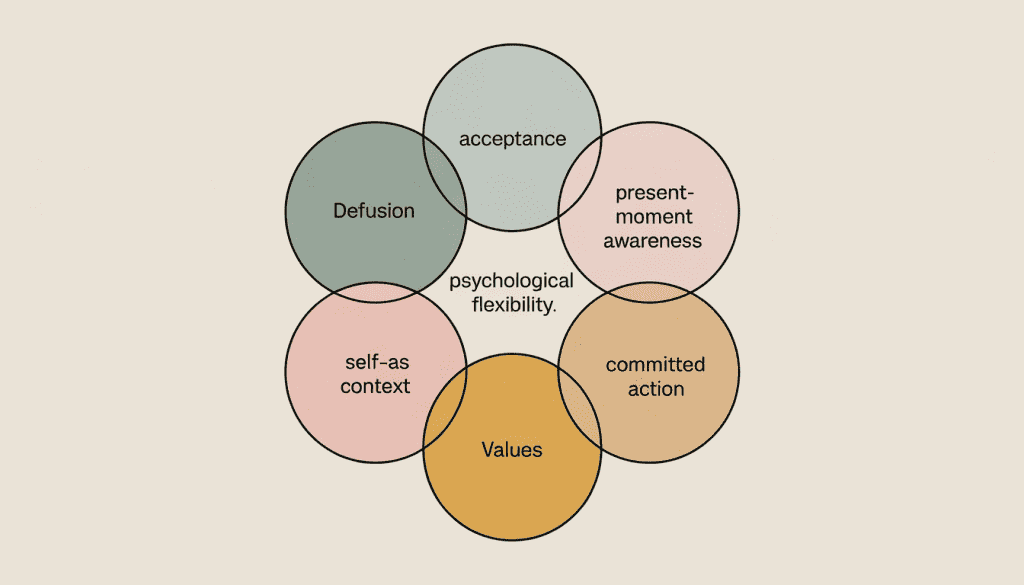
Understanding how ACT works helps you see why it’s different from anything you may have tried before. There are six interconnected skills at the heart of this approach, and together they build something called psychological flexibility — the ability to be present, open, and engaged in life even when it’s hard.
1. Defusion: Unhooking from Your Thoughts
Cognitive defusion is the practice of stepping back from your thoughts instead of getting tangled in them. When you’re “fused” with a thought, you treat it as an absolute truth. “I am worthless.” “Nothing will ever get better.” “I’m going to fail.”
Defusion doesn’t argue with those thoughts. Instead, it creates a little space between you and them. Techniques might include noticing a thought by saying “I’m having the thought that…” before repeating it, or imagining your thoughts as leaves floating down a stream.
Take Sarah, a 34-year-old teacher who had lived with the thought “I’m not good enough” for most of her adult life. It controlled her decisions, her relationships, her confidence. Through ACT, she didn’t eliminate that thought. She learned to notice it, name it — “There’s the ‘not good enough’ story again” — and carry it with her while still walking into the classroom and doing her job with care.
2. Acceptance: Making Room for Discomfort
Acceptance in ACT doesn’t mean giving up or pretending everything is fine. It means willingly making room for difficult feelings without fighting them or running away.
Think about the last time you felt anxious. What did you do? Most of us avoid the situation, distract ourselves, or numb the feeling somehow. That avoidance brings short-term relief — but it actually trains the brain to treat the emotion as a threat, making anxiety grow stronger over time.
ACT invites a different response: What if you just… let it be there? Not forever. Not because it’s pleasant. But because resisting it is costing you more than allowing it.
3. Present-Moment Awareness: Coming Back to Now
So much of our suffering lives in the past (regret, shame, loss) or the future (worry, dread, catastrophizing). ACT emphasizes bringing your attention back to the present — not as a form of mindfulness performance, but as a genuine act of reconnection with life as it actually is right now.
This doesn’t require meditation. It can be as simple as pausing and noticing what you can see, hear, or feel in your body in this very moment.
4. Self-as-Context: You Are More Than Your Thoughts
ACT makes a fascinating distinction. There’s the thinking self — the constant narrator in your head that judges, worries, and compares. And there’s the observing self — the part of you that can watch all of that happening without being swept away by it.
You are not your thoughts. You are the one noticing them. This shift in perspective can be genuinely life-changing for people who have spent years identifying with their anxiety, their depression, or their inner critic.
5. Values: What Actually Matters to You?
This is where ACT gets deeply personal. Values in ACT are not goals (things you achieve and then check off). They are directions — like compass points — that guide how you want to live, who you want to be, and what you want to stand for.
Are you someone who values courage? Connection? Honesty? Creativity? Kindness? Your values don’t disappear when life gets hard. They’re always there, quietly waiting for you to orient toward them.
6. Committed Action: Moving, Even When It’s Uncomfortable
The final piece is action. Not action that waits until you feel ready, or until the anxiety is gone, or until life is easier. Committed action means taking steps toward your values right now, even while carrying discomfort alongside you.
This is where acceptance and commitment therapy becomes something you live — not just understand.
What Does ACT Actually Help With?
Acceptance and commitment therapy has a surprisingly wide reach. Research has shown it to be effective for:
- Anxiety and worry (generalized anxiety disorder, social anxiety, panic)
- Depression (especially chronic low mood or depressive episodes)
- Chronic pain (changing the relationship with physical suffering)
- PTSD and trauma
- OCD (obsessive-compulsive disorder)
- Eating disorders
- Substance use and addiction
- Work-related stress and burnout
- Relationship difficulties
According to the American Psychological Association, ACT is recognized as an empirically supported treatment for a range of psychological conditions. The Association for Contextual Behavioral Science (ACBS) has catalogued hundreds of published studies supporting its effectiveness.
What makes ACT particularly valuable is that it works not just for people with clinical diagnoses. It’s also deeply useful for anyone who feels stuck, unfulfilled, or like they’re just going through the motions of life without really living it.
Real-Life Stories: What ACT Looks Like in Everyday Life
Marco, 41 — Chronic Pain and Isolation
Marco had lived with back pain for six years. The pain limited what he could do, and over time, he started avoiding everything that might make it worse. He stopped going out with friends. He stopped playing with his kids. He was “protecting” himself — but he was losing his life in the process.
Through acceptance and commitment therapy, Marco didn’t find a cure for his pain. But he found a way to stop letting it make every decision for him. He clarified that being a present father was a core value — and he started showing up for his kids, even on painful days, in whatever way he could.
Destiny, 28 — Social Anxiety and Perfectionism
Destiny was brilliant at her job but terrified of being seen. She avoided meetings, avoided friendships, avoided anything that might lead to judgment. Her anxiety told her she wasn’t interesting enough, smart enough, likeable enough.
ACT helped Destiny see that these were thoughts, not facts. She learned to let the anxiety be there without letting it cancel her plans. Over months, she started raising her hand in meetings, texting friends first, going to things she’d normally decline. The anxiety didn’t vanish. But it stopped running her life.
James, 55 — Grief After Loss
James lost his wife of 27 years and found himself unable to do anything that reminded him of her — which turned out to be almost everything. He stopped cooking the meals they loved. He stopped going to their favorite places. He was trying to protect himself from grief, but he was erasing her from his life in the process.
An ACT therapist helped James see that his avoidance was actually pulling him away from the things that honored her memory. His value of love and remembrance guided him back — carefully, painfully, but meaningfully — toward the life they had built together.
Priya, 32 — Burnout and Loss of Direction
Priya had done everything “right” — the degree, the career, the apartment. But she felt empty and exhausted and had no idea who she actually was outside of her achievements. She came to ACT not in crisis, but quietly lost.
Working through her values was a revelation. She realized she had been living according to what she thought she should want, not what she actually valued. Connection, creativity, and service. Slowly, she started making small changes that aligned her days with those truths.
Elijah, 23 — OCD and Intrusive Thoughts
Elijah had intrusive thoughts that horrified him. He’d spent years trying to neutralize them — checking, reassuring himself, avoiding triggers. The more he fought the thoughts, the louder they got.
ACT, in combination with Exposure and Response Prevention (ERP), helped Elijah understand that his thoughts weren’t commands or predictions. They were just thoughts. Learning to defuse from them — without the compulsive rituals — gradually returned his freedom.
How Is ACT Different from CBT?
You may already be familiar with Cognitive Behavioral Therapy (CBT), one of the most widely practiced approaches in the world. Acceptance and Commitment Therapy vs CBT is a common question — they share roots but diverge in meaningful ways. Here’s how they compare side by side:
| CBT | ACT | |
|---|---|---|
| Goal | Change unhelpful thoughts | Change your relationship with thoughts |
| Approach | Challenge and reframe negative thinking | Defuse from thoughts, accept feelings |
| Focus | Reducing symptoms | Building psychological flexibility and values-based living |
| Mindfulness | Sometimes included | Central to the approach |
Neither is “better” — they suit different people and different situations. For those who have tried CBT and found themselves stuck in endless thought-challenging without lasting relief, ACT can offer a genuinely different experience.
If you’re curious about finding the right fit for you, the Mindbloom article on how to know when to see a therapist is a wonderful place to start.
What to Expect in ACT Therapy
If you’ve never been to therapy before — or if therapy feels intimidating — knowing what to expect can make it a little easier to take the first step.
An ACT therapist won’t spend most of their time analyzing your childhood or challenging your thinking. Instead, sessions tend to be experiential. You might:
- Practice mindfulness exercises together
- Explore values through guided conversation and worksheets
- Use metaphors and stories to understand your patterns (ACT is well known for its use of creative metaphors)
- Practice defusion techniques with thoughts that have had a grip on you
- Identify where avoidance is limiting your life and gently experiment with different responses
Sessions are typically weekly and usually last 50 minutes. Most people begin to notice shifts within 8 to 12 sessions, though this varies significantly depending on the person and what they’re working through.
ACT is also widely available in a self-help format. Books like The Happiness Trap by Russ Harris and A Liberated Mind by Steven Hayes are considered excellent accessible introductions. The National Alliance on Mental Illness (NAMI) also provides helpful guidance on finding the right type of therapy.

Practical ACT Exercises You Can Try Right Now
You don’t need to be in therapy to begin exploring what acceptance and commitment therapy offers. Here are five practices you can start using today.
1. The “I Notice” Practice (Defusion)
The next time a painful thought arises, add the phrase “I notice I’m having the thought that…” before it.
Instead of: “I’m a failure.” Try: “I notice I’m having the thought that I’m a failure.”
This one small shift creates distance. The thought is still there — but you’re no longer inside it.
2. The Hands Exercise (Acceptance)
Hold your hands open, palms up, in front of you. Imagine your most difficult feeling sitting in them. Notice it. Look at it. Don’t push it away. You’re not carrying it because it’s good — you’re carrying it because pushing it away hasn’t worked, and your hands are big enough to hold it while you go on with your day.
3. The Values Compass (Values Clarification)
Take a piece of paper and write down five to ten areas of life: relationships, work, health, creativity, community, spirituality, parenting, learning. For each one, finish this sentence: “In this area of life, I want to be someone who…”
Don’t write goals. Write directions. These are your values. Read them back. Notice which ones make your chest feel something.
4. The Passenger on the Bus (Defusion Metaphor)
Imagine you are the driver of a bus. Your thoughts, fears, and memories are passengers. Some of them are loud and unpleasant. They might shout directions from the back. But you — the driver — still decide where the bus goes. The passengers can ride along. They don’t control the wheel.
5. One Values-Based Action Today
Look at your values compass. Choose one value. Then choose one small action — something you could do today — that moves in that direction. Not when you feel ready. Today. Even just five minutes of it.
This is the heart of committed action.
ACT and Mindfulness: What’s the Connection?
ACT is deeply rooted in mindfulness — but not in the “clear your mind and reach enlightenment” kind of way. Mindfulness in ACT is simply the practice of paying attention to the present moment, on purpose, without judgment.
It’s noticing your feelings without trying to change them. It’s watching your thoughts without getting swept away. It’s being here — in this ordinary, imperfect, sometimes painful moment — instead of somewhere else in your head.
For many people, the mindfulness component of acceptance and commitment therapy is the piece that most transforms their daily experience. Even brief daily practice — five to ten minutes of conscious breathing or body awareness — can begin to build the observational capacity that ACT relies on.
When ACT Is Especially Powerful
Acceptance and commitment therapy tends to shine brightest in a few particular circumstances:
- When you’ve tried traditional therapy and feel like something is missing
- When you’re dealing with chronic pain or illness and struggling to accept a new normal
- When perfectionism, avoidance, or people-pleasing are getting in the way of the life you want
- When you feel like you know what your problems are, but knowing doesn’t seem to help
- When you’ve lost touch with what you actually value or who you actually are
ACT is also particularly well-researched for anxiety disorders. According to Harvard Health Publishing, ACT approaches have shown real promise as alternatives or complements to traditional anxiety treatments.
The principles of ACT also pair naturally with understanding burnout and emotional exhaustion. If you recognize yourself in the patterns of emotional avoidance and disconnection from your values, you might also find Mindbloom’s guide on how resilience develops deeply resonant.
Common Misconceptions About ACT
“Acceptance means giving up.”
No. Acceptance means you stop fighting what you can’t control — your thoughts, your past, your feelings — so you have more energy for what you can control: your actions, your choices, your direction.
“ACT is just another form of positive thinking.”
Quite the opposite. ACT doesn’t ask you to think positively. It asks you to think openly — to make room for the negative without letting it run the show.
“You have to be in a crisis to benefit from ACT.”
Not at all. ACT is just as valuable for people who are functional but quietly unfulfilled, stuck, or disconnected from meaning. You don’t have to be at rock bottom to deserve support.
“It’s too spiritual or abstract for me.”
ACT can feel abstract at first — especially the metaphors. But it’s grounded in real behavioral science, and a good therapist will meet you exactly where you are.
How to Find an ACT Therapist
If acceptance and commitment therapy feels like it might be right for you, the next step is finding a therapist trained in this approach. Here’s how:
- Search the ACBS Therapist Directory at contextualscience.org — this is the most reliable directory for ACT-trained therapists worldwide.
- Check Psychology Today at psychologytoday.com and filter by “Acceptance and Commitment Therapy” as a treatment approach.
- Ask your primary care doctor for a referral to a therapist who specializes in ACT or “third-wave CBT.”
- Consider online therapy — platforms like BetterHelp and Talkspace include ACT-trained therapists, making access easier regardless of location.
When you contact a potential therapist, it’s completely okay to ask: “Are you trained in ACT? How do you typically use it in sessions?” A good therapist will welcome the question.
If you’re not sure whether you’re ready for therapy or what kind of support you’re looking for, Mindbloom’s guide on how to know when to see a therapist can help you figure that out with honesty and no pressure.
Building the courage to reach out is itself an act of commitment to your values. And if fear is what’s holding you back, exploring how resilience develops may give you the perspective to take that first step.
Living with ACT: You Were Never Broken
There’s a quiet lie that most of us have swallowed at some point: that the goal of life is to feel good all the time. That if we’re still anxious, still sad, still struggling, something must be wrong with us.
Acceptance and commitment therapy offers a different truth — one that is, in many ways, far more freeing. You are not a problem to be solved. Your pain is not evidence of failure. Your struggles are evidence of a human heart that has lived, felt, and loved.
The goal was never to eliminate discomfort. It was always to build a life big enough to hold it.
You don’t have to wait until you feel ready. You don’t have to wait until the fear quiets down or the sadness lifts. You can begin moving toward what matters to you right now — today — exactly as you are.
That’s what ACT is really asking. Not perfection. Not the absence of pain. Just: What do you value? And will you take one step toward it today?
The answer — whenever you’re ready — is yours.
Frequently Asked Questions About Acceptance and Commitment Therapy
1. What is Acceptance and Commitment Therapy (ACT) and what is it used for? Acceptance and commitment therapy (ACT) is used to treat anxiety, depression, PTSD, OCD, chronic pain, eating disorders, and addiction. It’s also widely used to improve quality of life, reduce burnout, and help people reconnect with meaning and purpose even without a formal diagnosis.
2. Is ACT better than CBT? Neither ACT nor CBT is universally better. CBT focuses on challenging and changing unhelpful thoughts. ACT focuses on changing your relationship with thoughts through acceptance and mindfulness. People who haven’t found lasting relief with CBT sometimes respond very well to ACT. Your therapist can help you determine which is a better fit.
3. How many sessions of ACT therapy does it take to see results? Many people begin to notice shifts in how they relate to their thoughts and feelings within 6 to 12 sessions. However, this varies depending on the person, the issue being addressed, and how consistently the skills are practiced between sessions.
4. Can I practice ACT on my own without a therapist? Yes, to a degree. Books like The Happiness Trap by Russ Harris and self-guided workbooks offer solid introductions to ACT principles. That said, working with a trained therapist provides guidance, accountability, and personalized support that self-help tools can’t fully replicate.
5. Does ACT involve mindfulness? Yes. Mindfulness is a central component of ACT. But in ACT, mindfulness is not about clearing your mind or achieving calm. It’s about learning to observe your thoughts and feelings with openness and curiosity, without getting swept away by them.
6. Is ACT evidence-based? Yes. Acceptance and commitment therapy has been extensively researched and is recognized as an empirically supported treatment for multiple conditions by organizations including the American Psychological Association. Hundreds of clinical studies have examined its effectiveness across a wide range of mental health challenges.
7. Does acceptance in ACT mean giving up or doing nothing? Acceptance in ACT means acknowledging what is true without needless struggle — particularly around internal experiences like thoughts and feelings you can’t control. Resignation implies giving up on life or change. ACT pairs acceptance with committed action toward your values — so it’s actually the opposite of giving up.
8. Can ACT help with trauma? Yes. ACT can be an effective approach for trauma, particularly when used alongside or integrated with trauma-focused therapies. It helps people develop psychological flexibility so that trauma-related thoughts and memories don’t completely control their behavior or close off their lives.
9. Is ACT available online? Yes. Many therapists offer ACT via telehealth sessions. You can find ACT-trained online therapists through the ACBS therapist directory, Psychology Today’s therapist finder, and therapy platforms like BetterHelp and Talkspace.
10. What are ACT values, and how do I find mine? In ACT, values are the personal qualities and directions that give your life meaning — things like honesty, love, creativity, courage, or service. They differ from goals because they’re ongoing directions rather than endpoints. You can begin exploring your values by asking yourself: “In the areas of life that matter most to me, who do I want to be?” Your answers — however imperfect — are your compass.
Have you come across ACT before — or is this your first time hearing about it? I’d love to know one word that describes how you relate to difficult thoughts or feelings right now. There are no wrong answers here. Drop it in the comments — I read every single one.
Disclaimer
This article is written for informational and educational purposes only and is not a substitute for professional mental health advice, diagnosis, or treatment. The content reflects general information about Acceptance and Commitment Therapy and is not intended as clinical guidance. If you are experiencing a mental health crisis or believe you may need professional support, please reach out to a qualified mental health professional or contact a crisis helpline in your area. Mindbloom is a personal blog for growth and support, not a mental health service.