
Nonviolent Communication: How It Works and How to Use It in Real Relationships

Have you ever walked away from an argument with someone you love and thought: why does this always end this way? You said things you didn’t mean. They shut down. Or maybe you were the one who went quiet, swallowing everything you actually felt because it just never comes out right.
There’s a name for what most of us are missing in those moments — and it’s called nonviolent communication. If that sounds unfamiliar, you’re not alone. Most people have never been taught how to speak from their real feelings instead of their defenses. But once you learn it, you won’t be able to unsee it.
Nonviolent communication (also called NVC) is a way of speaking and listening that has the power to transform even the most stuck, painful relationship dynamics. Developed by psychologist Marshall Rosenberg in the 1960s, it’s a simple framework rooted in empathy, honesty, and the belief that every human being has the same core needs. And once you understand it, you’ll start seeing communication patterns everywhere — in your relationships, your friendships, and even in how you talk to yourself.
This article will walk you through what nonviolent communication is, why it works, how to actually use it in real life, and how to start practicing it today — even if conflict has always felt impossible for you.
Table of Contents
What Is Nonviolent Communication, Really?
The name can feel a little confusing at first. Nobody is suggesting that you’ve been violent in your conversations. What Marshall Rosenberg meant by “violence” was something more subtle: the kind of communication that creates distance, pain, and disconnection — even when that’s never what we intended.
Think about the last time you said something like:
- “You never listen to me.”
- “You’re so selfish.”
- “Why do you always do this?”
None of those feel like attacks on the surface. They feel like honest expressions of frustration. But according to the principles of nonviolent communication, those kinds of statements actually block real connection, because they put the other person on the defensive and pull the focus away from what’s actually going on underneath.
NVC, at its core, is about getting back to what’s real: your feelings, your needs, and the genuine human connection you’re craving.
According to the Center for Nonviolent Communication, NVC is grounded in the idea that all human beings share the same basic needs, and that conflict arises not from people being bad or wrong, but from strategies that don’t align. When you can understand your own needs and the needs of the person you love, everything shifts.
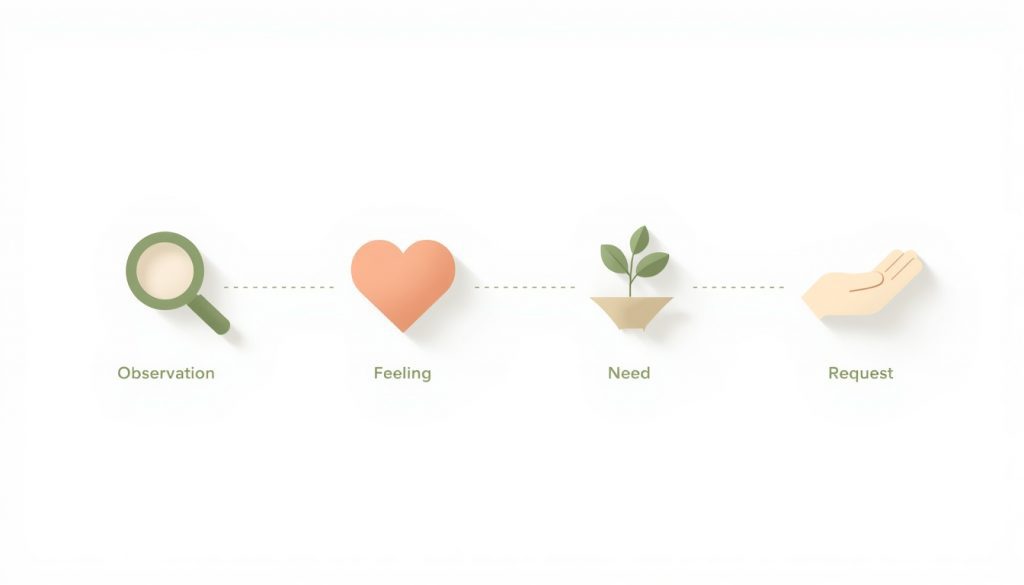
The Four Steps of Nonviolent Communication
Rosenberg identified four simple but profound components to NVC. Think of them less as rigid steps and more as a new way of seeing every interaction.
1. Observation (Without Evaluation)
This is about describing what happened as factually as possible, without judgment or interpretation layered on top.
Instead of: “You were totally checked out last night.” Try: “You were on your phone for most of dinner last night.”
One is a story. The other is just what happened. The difference matters enormously, because when people feel judged, they defend themselves instead of connecting.
2. Feelings (Not Thoughts Disguised as Feelings)
This step asks you to identify and name what you’re actually feeling — not what you think about the situation.
“I feel like you don’t care about me” is actually a thought, not a feeling. A feeling would be: “I felt lonely” or “I felt hurt.”
This distinction is surprisingly hard. Most of us were never taught to name our emotional states with any real precision. But the more specific you can be, the more real and relatable you become to the person you’re talking to.
3. Needs (The Heart of Everything)
Every feeling points to an underlying need. Loneliness points to a need for connection. Anxiety about being ignored points to a need for acknowledgment or security. Anger about being interrupted points to a need to be heard.
NVC says: when you can name the need, you give the other person something real to respond to. You stop being a problem for them to solve and start being a human being with a heart.
4. Requests (Not Demands)
A request is specific, positive, and present-focused. It tells someone what you’d like, not what they did wrong.
Instead of: “Stop ignoring me.” Try: “Would you be willing to put your phone away during dinner this week?”
One closes down. The other opens things up.
Why Nonviolent Communication Feels So Unnatural at First
Here’s the honest truth: the vast majority of us grew up in homes where emotions were either minimized (“You’re being too sensitive”), weaponized (“Look what you made me do”), or simply never talked about at all.
We learned to communicate through blame because that’s what we saw modeled. We learned to protect ourselves by going silent, or by going loud. We never got the memo that there was another way.
If you’re reading this and thinking, this sounds nothing like how I grew up talking — that’s okay. That’s actually the whole point. Nonviolent communication isn’t natural for most people at first. It takes practice, patience, and a genuine desire to connect more than you want to be right.
Real-Life Scenarios Where NVC Changes Everything
Scenario 1: The Partner Who Feels Unheard
Maya has been trying to tell her partner, James, that she feels disconnected lately. Every time she brings it up, James gets defensive and says he’s been “working so hard for them.” The conversation always ends in silence.
With NVC, Maya might say: “When we don’t talk much during the week (observation), I feel distant and a little lonely (feeling). I need us to feel close and connected (need). Would you be open to having a proper conversation without phones on Friday evenings? (request)”
James doesn’t need to defend his work ethic. He can hear her now.
Scenario 2: The Friend Who Always Cancels
You have a close friend who cancels plans at the last minute. You’ve started feeling resentful, and you know that if you don’t say something, you’ll just pull away quietly.
Instead of: “You always do this. You clearly don’t value my time.”
NVC version: “When our plans get canceled the day of (observation), I feel disappointed and a little unimportant (feeling). I really value our friendship and I need to feel like it matters (need). Could we talk about how to make plans that work better for both of us? (request)”
That last sentence keeps the door open instead of slamming it shut.
Scenario 3: The Argument That Goes in Circles
David and his partner Priya fight about the same things on rotation: dishes, money, who’s carrying more emotional weight. The content changes, but the pattern never does.
NVC doesn’t eliminate conflict. But it does interrupt the cycle. When David pauses and says, “I don’t want to keep fighting about this. Can I tell you what I’m actually feeling right now?” — something shifts. Not because the problem is solved, but because the conversation just became honest.
Scenario 4: Communicating With an Anxious Parent
If you have a parent who responds to everything with worry or criticism, NVC can help you stop either shutting down or blowing up. When your mom says, “You never call anymore,” instead of getting defensive, you might respond: “It sounds like you’ve been missing me. I miss you too. Can we figure out a time that works regularly?”
You just met her need and yours, without anyone having to be wrong.
Scenario 5: Talking to Yourself After a Hard Day
Nonviolent communication isn’t only for conversations with others. It’s also a powerful tool for how you speak to yourself.
Instead of: “I’m so stupid for saying that.” Try: “I felt embarrassed in that moment because I really needed to be understood. What would help me right now?”
That’s the same compassion you’d offer a dear friend, turned inward. Understanding how you talk to yourself is foundational — you can explore this deeper with our articles on emotions and healing, which go into the inner world most people are afraid to look at.

What Nonviolent Communication Is NOT
It’s worth clearing up a few common misunderstandings.
NVC is not about being passive. You still get to have opinions, set limits, and say hard things. It’s about how you say them.
NVC is not a magic fix. If someone doesn’t want to connect or isn’t open to hearing you, no framework will force that. It takes two people willing to try.
NVC is not weakness. It takes far more courage to be honest about your feelings and needs than to attack or withdraw. The people who do this work consistently tend to build relationships that are genuinely deep, not just polite.
NVC is not therapy — though it is often used alongside therapeutic work. If you’re navigating more complex relationship trauma, understanding when to seek therapy and professional help can make a meaningful difference in how you move forward.
NVC is not about suppressing anger. You’re allowed to feel angry. NVC simply asks you to look beneath the anger — to the hurt, fear, or unmet need that’s actually driving it — and speak from there instead.
The Science Behind Why It Works
Research consistently shows that how we communicate directly affects the emotional safety we feel in our relationships — and emotional safety is the foundation of everything: intimacy, trust, conflict resolution, and long-term connection.
The Gottman Institute, which has studied thousands of couples for decades, found that the most destructive communication patterns in relationships are criticism, contempt, defensiveness, and stonewalling. NVC, by design, directly addresses all four of these — it reduces criticism by focusing on observation, counters contempt with empathy, lowers defensiveness by expressing needs rather than accusations, and breaks stonewalling by creating a safe enough environment to actually speak.
The American Psychological Association also notes that the way couples handle conflict is one of the strongest predictors of relationship satisfaction. It’s not whether you argue — it’s how.
On a neurological level, when we feel attacked, our nervous system goes into fight-or-flight. The prefrontal cortex — the part of the brain responsible for nuanced thinking, empathy, and problem-solving — literally goes offline. NVC, by removing the perceived threat from a conversation, helps both people stay regulated enough to actually think and feel clearly. Harvard Health supports this connection between emotional regulation and the body’s stress response.
How to Start Practicing Nonviolent Communication Today
You don’t need to be in a relationship or have a specific conflict to begin. Here are practical, actionable steps you can take right now.
Start With a Feelings Vocabulary
Most of us have a tiny emotional vocabulary: happy, sad, angry, fine. That’s it. Expanding it is genuinely life-changing. Look up an NVC feelings list — you’ll find words like deflated, overwhelmed, tender, restless, numb — and start noticing which ones resonate throughout your day.
Practice the Four-Step Formula in Low-Stakes Situations
You don’t need to start with your most fraught relationship. Try NVC in a small way with a coworker, a friend, or even in a journal entry. The more you practice the structure, the more natural it becomes.
Slow Down Before Responding
Reactive communication is the enemy of nonviolent communication. When you feel triggered, try pausing for even 30 seconds. Breathe. Ask yourself: What am I actually feeling right now? What do I actually need?
That pause is where everything changes.
Try Empathic Listening First
Before jumping to your own NVC statement, try receiving someone else’s words with empathy first. That means listening for the feeling and need underneath what they’re saying, even if what they’re saying sounds like an accusation.
If your partner says, “You never support me,” instead of defending yourself, try: “It sounds like you’ve been feeling really unsupported. Is that right?”
That one question can completely change the trajectory of a conversation.
Journal It Out
If real-time NVC feels overwhelming, start with a journal. When something upsets you, write it out in the four-part format: What did I observe? What did I feel? What do I need? What would I like to request?
This practice also connects deeply to the kind of inner work explored in growth and resilience — because changing how you communicate starts with understanding who you are.
Be Patient With Yourself
You will not be perfect at this. You’ll lose your patience, revert to old habits, and say things you regret. That’s completely human. The goal isn’t perfection. It’s a slow, consistent shift toward more honest, kind, and connected conversations.
When the Other Person Doesn’t Know NVC
This comes up a lot: What if I’m the only one trying?
Here’s the honest answer: even when only one person in a conversation is using nonviolent communication, the dynamic shifts. You can’t control how someone responds, but you can change what you put into the space between you.
When you stop escalating, they often stop too. When you speak from vulnerability instead of attack, it becomes harder for the other person to fight back with cruelty. Not always — but often enough that it’s worth the effort.
And sometimes, the most powerful thing you can do is model it quietly. Not as a lecture, not as a tactic — just as a genuinely new way of showing up.
If you’re in a relationship where one person is consistently unwilling to engage, it’s worth exploring whether the relationship dynamics you’re experiencing connect to love and relationships patterns that go deeper than communication style alone.
Nonviolent Communication and Healthy Boundaries
One thing that surprises people is that NVC is actually one of the most powerful frameworks for setting limits — not the weakest.
Because when you can say clearly: “When this happens, I feel this, and I need this,” you’ve just articulated a boundary in the most direct, least accusatory way possible. You’re not threatening. You’re not guilting. You’re simply telling the truth about what you need to feel okay in a relationship.
Limits communicated through NVC tend to land differently than limits delivered with anger or ultimatums. They’re more likely to be respected, more likely to be understood, and more likely to actually hold.
Understanding how to communicate your limits through a framework like nonviolent communication also feeds directly into building healthy romantic relationships — because safety and honesty are the bedrock of any love that lasts.
Why Nonviolent Communication Is an Act of Love
There is something quietly radical about deciding to speak from your heart instead of your armor.
Nonviolent communication isn’t just a communication technique. It’s a way of saying: I believe the person in front of me is worthy of my honesty, and I believe I am worthy of being truly heard. It is, at its core, an act of love — toward others and toward yourself.
The conversations that have changed us most in life weren’t the ones where someone was the loudest or the cleverest. They were the ones where someone looked at us and said: I see you. I hear you. And I’m not going anywhere.
You can be that person in someone else’s life. And you deserve that person in yours.
Start with one conversation. One observation, one honest feeling, one need spoken out loud. That’s all it takes to begin. I believe that kind of courageous honesty is one of the most healing things a person can do.
Frequently Asked Questions
1. What does nonviolent communication mean in relationships? Nonviolent communication in relationships means expressing your feelings and needs honestly without blame, judgment, or criticism — and listening to your partner with the same empathy. It’s a way of connecting more deeply rather than “winning” arguments.
2. Is NVC the same as being passive or avoiding conflict? No. Nonviolent communication encourages honest expression of needs and limits. It’s not about avoiding hard conversations — it’s about having them in a way that creates connection rather than more distance.
3. Can NVC really improve a damaged relationship? Yes, it can help — especially when both people are willing to try. Many couples and families have used NVC to break long-standing patterns of reactive, hurtful communication. However, deeply damaged relationships may also benefit from working with a therapist alongside practicing NVC.
4. How long does it take to learn nonviolent communication? You can understand the four-part framework in minutes, but using it naturally under emotional stress takes consistent practice over weeks or months. Most people start seeing real shifts within a few weeks of intentional practice.
5. What is the difference between a feeling and a thought in NVC? A feeling is an emotional state: sad, afraid, relieved, frustrated. A thought disguised as a feeling is something like “I feel like you don’t care” — that’s actually an interpretation of someone else’s behavior, not a description of your inner emotional state.
6. Can I use NVC with someone who is angry or defensive? Yes. In fact, NVC is particularly useful with defensive people because it removes the accusatory language that usually triggers defensiveness. Leading with empathy — “It sounds like you’re really overwhelmed” — can shift the entire tone of an interaction.
7. Is there research supporting nonviolent communication? Yes. The core principles of NVC — empathic listening, emotional expression, de-escalation, and needs-based communication — are well-supported by relationship psychology research, including the decades-long work of John Gottman and Carl Rogers’ person-centered therapy model. While RCT-style studies on NVC as a branded protocol are still limited, its foundational components are among the most studied in the field of interpersonal communication.
8. What are the four components of NVC? The four components are: Observation (what you factually saw or heard), Feeling (your emotional response), Need (the underlying human need behind the feeling), and Request (a specific, actionable ask of the other person).
9. Can I use nonviolent communication with children? Absolutely. NVC is widely used in parenting and education. Teaching children to name their feelings and needs — and modeling that yourself — builds emotional intelligence that benefits them their entire lives.
10. What is the biggest mistake people make when trying NVC? The most common mistake is using the structure as a script to mask blame — for example: “When you do X, I feel like you’re being selfish.” That’s not NVC; it’s criticism dressed in NVC language. True NVC requires genuine vulnerability and the willingness to take responsibility for your own emotional experience.
Is there a conversation you’ve been putting off — one where you know what you feel, but not how to say it? Drop it in the comments. You don’t have to have it all figured out.
Disclaimer
The content on Mindbloom is written for informational and personal growth purposes only. It is not a substitute for professional mental health advice, diagnosis, or treatment. If you are experiencing a mental health crisis or need clinical support, please reach out to a licensed therapist, counselor, or mental health professional. In the case of an emergency, contact your local emergency services or a crisis helpline immediately.