
Grieving a Lost Career: Why It Hurts So Much (and How to Heal)
Nobody warns you that grieving a lost career can feel like grieving yourself — not just a paycheck, not just a title, but the entire identity you built around what you did every day.
The version of you that walked through those doors every morning, knew exactly where you fit, and had a ready answer when someone asked, “So, what do you do?” Grieving a lost career is a real, painful, and deeply misunderstood kind of loss — and if you are sitting in the middle of it right now, wondering why you still feel so hollow even weeks or months later, this article was written for you.
We live in a culture that ties identity to occupation more tightly than we like to admit. Your career was not just a job. For many people, it was their structure, their community, their sense of purpose, and the lens through which they understood themselves. When it disappears — through a layoff, a forced career change, a health crisis, retirement, or even a dream job that slowly crushed your spirit — it leaves behind a grief that looks a lot like loss, because it is loss.
And it deserves to be treated that way.
This guide is here to help you understand what grieving a lost career actually looks like, why it hits so hard, and how to begin building something new — without rushing yourself, minimizing your pain, or pretending that a fresh LinkedIn profile is all you need.
Table of Contents
Why Losing a Career Feels Like Losing a Part of Yourself
Think about the last time someone introduced themselves to you. The first thing most people say, after their name, is what they do.
“I’m a nurse.” “I’m a teacher.” “I’m an engineer.”
We are, in many ways, shaped by our work. It structures our mornings. It fills our social calendar. It tells us who we are in relation to the rest of the world. According to research published by the American Psychological Association, work is deeply connected to our sense of identity, self-worth, and social belonging — especially in cultures like the United States where career achievement is treated as a core personal value.
So when that career ends, something deeper cracks. The loss is not just external. It is existential. You are not just grieving a job. You are grieving a version of yourself.
This is sometimes called identity foreclosure — when the path you were on, the role you played, or the self-concept you built suddenly disappears. Psychologists have long recognized that significant role losses trigger real grief responses. And yet, our culture rarely validates career grief the way it validates grief over death or divorce.
That invalidation makes the pain even harder to carry.
Types of Career Loss: Which One Are You Grieving?
Grieving a lost career does not always look the same. It arrives in many different forms, and recognizing yours might be the first step to understanding what you are carrying.
The Sudden Layoff
Marcus had worked in marketing for 14 years. He built campaigns he was proud of, mentored junior staff, and genuinely loved Monday mornings. Then one Tuesday, HR called him into a conference room. Within 20 minutes, his badge stopped working and his email was gone. He drove home in a daze, sat in his driveway for an hour, and told his wife he was “fine.” It took three months before he admitted he had not been fine at all — that he cried in the shower, that he felt embarrassed to run into neighbors, and that some mornings he simply could not get out of bed.
The Career That Stole Your Health
Priya had always been driven. She became a corporate attorney at 27, worked 70-hour weeks, and was on track to make partner. Then her body started breaking down — panic attacks, insomnia, a stomach that refused to cooperate. Her doctor was blunt: keep going and pay the consequences, or stop. She chose to stop. And then she spent the next year grieving the identity she had spent a decade building, even though she was the one who walked away.
The Retirement Nobody Warned You About
Robert retired at 65 after a 35-year career as a high school principal. Everyone congratulated him. His family threw a party. And then — nothing. The calendar was empty. The phone stopped ringing. The sense of purpose that had carried him for three decades evaporated overnight. He found himself wandering the house at 7 a.m. wondering what he was supposed to do now. What he felt was not laziness. It was grief.
The Dream That Didn’t Work Out
Leah spent her twenties building a career as a professional dancer. She sacrificed relationships, money, stability — all of it for the art she loved. At 32, a knee injury ended her performing career. She transitioned into marketing, made more money than she ever had, and still cried in the car on the way home because none of it felt like her.
The Slow Erasure
Sometimes career grief is not a single event. It is a slow erosion — a promotion that went to someone else for the fifth time, a role that slowly became unrecognizable, a company culture that shifted until there was no longer any space for who you are. This kind of loss is particularly hard to validate, because from the outside, nothing dramatic happened. But inside, a piece of you has been quietly disappearing for years.
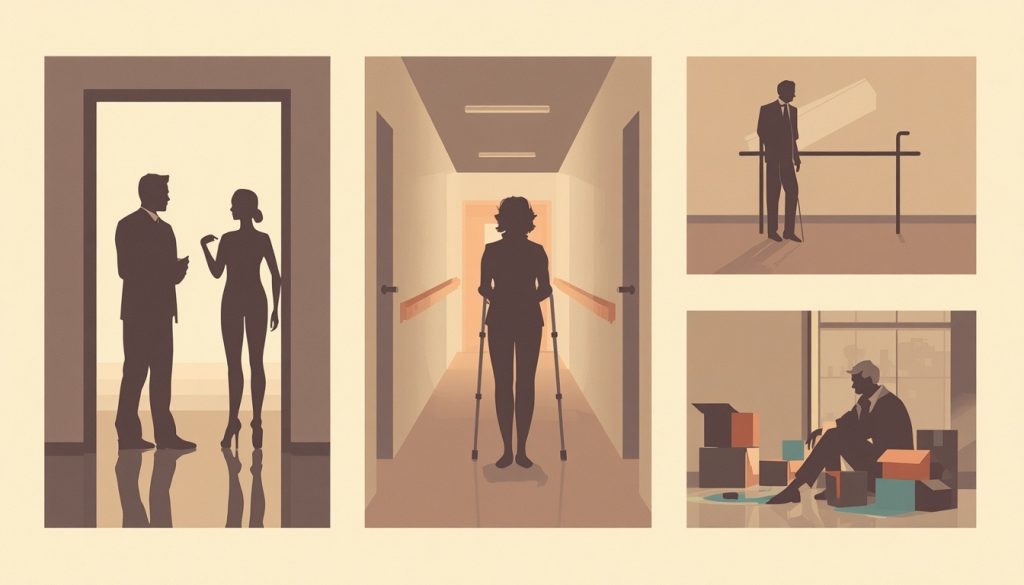
Signs You’re Grieving a Lost Career (And Why That’s Completely Normal)
If you have been wondering whether what you are feeling is “normal,” here are some of the most common emotional experiences that come with career and identity loss — none of which mean something is wrong with you.
Shame and embarrassment. Especially in cultures that equate worth with productivity, there is often a deep and quiet shame in losing your career. You may avoid certain conversations, decline social invitations, or feel a flush of heat when someone asks what you are up to these days.
Disorientation and purposelessness. Without the structure of work — the meetings, the goals, the routine — many people describe feeling like they are floating. Days blur together. Motivation disappears. It can look like depression from the outside (and sometimes it does overlap).
Anger. At the company that let you go. At yourself for not doing more. At the system. At how unfair it all is. Anger is a completely valid part of career grief and it often shows up when the shock wears off.
Relief mixed with guilt. This one is tricky — and more common than you’d think. Sometimes, especially for people who left toxic environments or were burning out badly, the first thing that comes after the loss is genuine relief. The weight lifts. The dread of Monday mornings disappears. And then, almost immediately, the guilt arrives: How can I feel relieved about something I’m supposed to be mourning? The answer is that both feelings are allowed to exist at the same time. Relief doesn’t cancel grief. It just means you were carrying more than you realized.
A deep questioning of who you are. If you are not your job, then who are you? This question can feel terrifying when you have spent years answering it with a job title.
The Kübler-Ross grief model — originally designed for processing death — has been applied broadly to all kinds of loss, including career loss. Denial, anger, bargaining, depression, and acceptance do not always come in order, and they do not always end cleanly. But recognizing that what you are going through is a grief process can be enormously validating.
Why We Don’t Talk About This Enough
There is a reason grieving a lost career gets minimized, both by others and by ourselves.
In America especially, there is an unspoken rule that work-related suffering should be handled quickly and efficiently. You grieve, you update your resume, you “bounce back.” The message is: this is not real loss. Real loss is reserved for death, illness, and heartbreak.
But that narrative is not only unhelpful — it is harmful. It pushes people into performative recovery, where they pretend to be okay while the grief quietly accumulates underneath. It tells people to “stay positive” when what they actually need is permission to fall apart first.
If the people around you do not understand why you are still struggling, it may help to read about emotional validation and how much it matters in healing. You can explore more about this on how to process difficult emotions during career loss.
Research from the National Alliance on Mental Illness (NAMI) consistently shows that unacknowledged grief — grief that does not receive social validation — leads to more complicated and prolonged suffering. In other words, minimizing career grief does not make it go away. It makes it worse.
How Career Loss Touches Your Whole Life
One thing that makes grieving a lost career so complicated is that it rarely stays in one lane.
Your relationships shift. Your sense of status, your social identity, even the way you relate to your partner, friends, or family can feel shaky when your career disappears. Some people pull away. Others become irritable or hard to reach. Some couples experience serious strain when one partner loses their job and the dynamic of the relationship changes.
If you have noticed strain in your connections during this time, the Love & Relationships section on Mindbloom has some honest, supportive writing on navigating closeness during difficult seasons.
Your body feels it. Loss of career can manifest physically — disrupted sleep, changes in appetite, fatigue, tension headaches, a body that just feels heavy. This is not you being dramatic. The American Institute of Stress recognizes job loss as one of the most significant life stressors, with measurable physiological effects. Your nervous system is responding to a genuine threat.
Your confidence takes a hit. Even people who were objectively excellent at their careers report a sharp drop in self-confidence after losing a job or making a career transition. Imposter syndrome can get louder. The inner critic can become relentless.
Your sense of the future changes. When your career disappears, so does the version of the future you were building toward. That is a very specific kind of grief — grieving not just what was, but what you thought was coming.
Grieving a Lost Career: Practical Steps That Actually Help
There is no checklist that makes this painless. But there are things that genuinely help — not to speed up the grief, but to support yourself through it with more grace and less suffering.
1. Get Specific: Name Every Layer of What You’ve Lost
Before you start rebuilding, give yourself permission to name the loss in full. Not just “I lost my job.” But: I lost my daily structure. I lost my professional community. I lost the version of myself I was proud of. I lost the feeling of being needed and good at something. Write it down if you need to. Naming the specific layers of loss is not wallowing — it is necessary.
2. Let Go of the Timeline
There is no standard length for career grief. Do not let anyone — including yourself — pressure you into a recovery schedule. Some people feel okay within weeks. Others carry it for a year or more. Both are valid. Grief does not operate on your productivity calendar.
3. Give Your Nervous System Something to Hold Onto
Without work structuring your days, the hours can feel formless and suffocating. You do not need a rigid schedule — but small anchors help. A regular time you wake up. A walk after breakfast. One meaningful task in the afternoon. These are not about being productive. They are about giving your nervous system a thread to hold onto.
4. Let Yourself Be Angry and Sad Without Judgment
Cry if you need to. Be angry if you need to. Talk it out with someone you trust. Journaling can be incredibly powerful here — not polished, not optimistic, just honest. The emotions need somewhere to go. If you push them down, they will find their own way out — usually at the worst possible moments.
5. Remember: You Are Not Your Job Title
This one is hard, and it will not happen overnight. But start asking: Who am I when I am not my job title? What do I love that has nothing to do with a résumé? What do people who love me value about me? These questions are not easy. But they are the beginning of rebuilding an identity that is rooted in something more durable than any job.
6. Reach Out — Not to Network, But to Connect
In the early stages of career grief, social connection matters enormously — not for professional reasons, but for human ones. Call a friend you have not spoken to in a while. Say honestly, “I’m having a hard time.” You do not need advice. You need to be heard.
7. Consider Talking to a Professional
There is no shame in this. Career grief, especially when it intersects with burnout, identity loss, or depression, can be difficult to process alone. A therapist who understands occupational identity and grief can help you untangle what you are feeling and find a path forward. If you are not sure where to start, the Therapy & Professional Help section on Mindbloom has approachable, judgment-free guidance on taking that first step.
8. Hold the Future Loosely
You do not have to know what comes next. Not yet. Healing first. Rebuilding second. Resist the pressure to have it all figured out. The next chapter is not something you plan your way into — it is something you grow into.

Finding Yourself on the Other Side
Grief, when you actually move through it instead of around it, has a strange way of returning things to you.
Something quietly remarkable happens when you allow yourself to grieve a lost career fully instead of skipping to the part where you are supposed to have it together.
You start to hear things about yourself that the noise of your old role was drowning out. You notice interests that had been waiting patiently for years. You discover strengths that were never celebrated in your previous context. You begin to ask — not anxiously, but with genuine curiosity — Who am I, really?
This is where resilience is actually born. Not in the polished comeback story. Not in “everything happens for a reason.” But in the quiet, uncomfortable work of sitting with loss long enough to hear what it is trying to teach you. If you want to understand how real resilience actually forms, how resilience develops is an honest and science-backed look at what that process truly looks like.
Career grief is also an invitation to examine the stories you have been telling yourself about success, worth, and what a meaningful life looks like. Many people on the other side of this grief describe it as one of the most disorienting — and ultimately transformative — experiences of their lives. Not because it was easy. But because it cracked them open in ways that a comfortable career never could.
Rebuilding Identity After Career Loss: You’re Not Starting Over
There is a sentence that circulates in personal development spaces that has always felt a little hollow: “It’s never too late to start over.”
Maybe what is more true — and more honest — is this: you are not starting over. You are starting differently. With everything you have learned. With the parts of yourself your career never had room for. With a clearer sense, however raw and incomplete, of what actually matters to you.
Grieving a lost career is not weakness. It is not drama. It is not something to be ashamed of or rushed through. It is the honest, human response to a real and significant loss.
And on the other side of it — if you let yourself go through it instead of around it — there is something waiting for you. It might look different from what you imagined. It might be quieter, or slower, or less impressive to the world. But it will be more yours than anything you have ever had before.
You are allowed to grieve this. You are allowed to take your time. And you are not as alone in this as it feels right now.
Frequently Asked Questions About Grieving a Lost Career
1. Is it normal to grieve a lost job? Absolutely. Career loss is a recognized form of grief. Losing a job means losing structure, identity, social belonging, income, and often a sense of purpose — all at once. Emotional pain after this kind of loss is not weakness; it is a completely natural human response.
2. How long does career grief last? There is no universal timeline. Some people begin to feel more stable within a few months. Others take a year or longer, particularly if the career was deeply tied to their identity. Grief generally eases as you begin to build new routines, connections, and sources of meaning — but rushing the process tends to make it worse.
3. Why do I feel more upset about losing my career than about other losses? This is more common than people realize. In cultures where work equals worth, career loss can feel more destabilizing than other kinds of loss because it threatens not just your livelihood but your social identity and self-concept. It also affects your daily structure in a way that few other losses do.
4. What is the difference between career grief and depression? Career grief and depression can overlap and look similar — low motivation, disrupted sleep, withdrawal, sadness. The key difference is that grief tends to come in waves and is connected to a specific loss, while depression is more pervasive and persistent. If you are struggling to function, losing interest in everything, or having thoughts of self-harm, please reach out to a mental health professional.
5. How do I stop feeling ashamed about losing my career? Shame after career loss is incredibly common — especially in cultures where your job title is treated as your worth. The first step is recognizing that shame is not the truth; it’s a conditioned response. Talking about what happened with someone you trust, even briefly, begins to loosen shame’s grip. Remember: the circumstances that ended your career reflect a situation. They do not reflect your value as a person.
6. Can losing a career cause a full identity crisis? Yes, particularly for people whose career was central to their sense of self. Psychologists refer to this as a “role exit” — when you leave a role that was defining, it can cause disorientation and a need to reconstruct your identity from the ground up. This is hard, but it is also a genuine opportunity for deeper self-discovery.
7. How do I explain career grief to people who don’t understand? You might try: “Losing this career felt like losing a part of who I am, not just a paycheck.” Most people will understand that even if they haven’t experienced it themselves. You do not owe anyone a full explanation of your grief. Share only with those who are safe.
8. Is it okay to feel relieved after losing my career? Yes. Relief is a completely valid emotion, especially if the career was stressful, toxic, or harmful to your health. Relief does not mean the grief is not also real. Both feelings can coexist.
9. Should I start job searching right away after a career loss? Not necessarily. While practical pressures may require action, there is value in giving yourself at least some time to grieve before diving into an identical path. Many people find that forcing themselves into the same lane too quickly prevents them from noticing whether a different path might serve them better.
10. How do I rebuild a sense of identity after career loss? Slowly and intentionally. Start by separating your worth from your title. Reconnect with interests, values, and relationships outside of work. Ask yourself what kind of person you want to be — not what you want to do. Identity rebuilding after career loss is a gradual process, but it is one of the most meaningful journeys a person can take.
11. When should I seek professional help for career grief? If your grief is significantly affecting your ability to function, your relationships, your physical health, or your mental health for an extended period, please consider speaking with a therapist. There is no shame in asking for support — and career grief, when it overlaps with burnout or identity disruption, often benefits enormously from professional guidance.
Have you ever lost a career that felt like losing a part of yourself? I want to hear from you — not the polished version, just the honest one. Drop one thing in the comments below that you felt but never said out loud. This is a safe space, and every word here is welcome.
Disclaimer
This article is written for general informational and emotional support purposes only. It is not a substitute for professional mental health advice, diagnosis, or treatment. If you are experiencing severe emotional distress, symptoms of depression, or a mental health crisis, please seek support from a qualified mental health professional or contact a crisis helpline in your area. The experiences described in this article are illustrative scenarios created for relatability; they do not represent specific real individuals.