
Pomodoro Technique and Time Blocking: Your Complete Guide to Focused, Calmer Days

Does your day ever feel like it belongs to everyone except you?
You sit down to work. A notification pings. Someone needs something. You switch tasks, lose your place, and by 4 PM you’re staring at a half-finished to-do list wondering where the hours went. You weren’t lazy. You weren’t distracted on purpose. You were just never given a better system.
That’s exactly why the Pomodoro technique and time blocking have become two of the most widely adopted focus methods in the world of productivity and mental wellness. Not because they’re complicated or require any special app or gadget. But because they work with your brain instead of against it. And once you understand how, you’ll wonder how you ever worked any other way.
This article is for you if your mind races the moment you sit down to focus. If you lose hours to task-switching. If you go to bed feeling busy but not productive. If focus feels like something other people have and you don’t.
You’re not broken. You just need a system that fits how humans actually think.
Table of Contents
What You’ll Learn in This Article
- What the Pomodoro technique actually is (and why it works for anxious, scattered minds)
- What time blocking is and how it pairs beautifully with the Pomodoro method
- Real-life scenarios where both techniques make a genuine difference
- A step-by-step guide to building your own Pomodoro and time blocking routine
- The mental health benefits of working in focused bursts
- Common mistakes people make (and how to avoid them)
- Answers to the most asked questions about both methods
What Is the Pomodoro Technique? (And Why Your Brain Will Love It)
The Pomodoro technique was created in the late 1980s by Francesco Cirillo, an Italian student who was struggling to focus while studying. He picked up a tomato-shaped kitchen timer (pomodoro means tomato in Italian), set it for 25 minutes, and committed to working on just one thing until it rang.
That simple experiment became one of the most widely used focus methods in the world.
Here’s how it works:
- Choose one task to work on
- Set a timer for 25 minutes
- Work on that task, and only that task, until the timer rings
- Take a 5-minute break
- After four rounds (called pomodoros), take a longer break of 15 to 30 minutes
That’s it. Beautifully simple.
Why a 25-Minute Focus Timer Works Better Than Willpower
A focus timer removes the open-ended pressure of “I need to concentrate for as long as it takes.” It replaces vague effort with a defined, winnable game — and your brain responds to that completely differently than it does to a blank horizon of unspecified work.
But here’s what makes it more than just a timer trick. When you know you only have to focus for 25 minutes, the mental resistance melts away. You’re not committing to hours of grinding. You’re just committing to this one block, this one task, right now. For people who deal with anxiety, ADHD tendencies, or chronic overwhelm, that short horizon is genuinely life-changing.
The built-in breaks also prevent the mental fatigue that sneaks up on you when you try to white-knuckle your way through a five-hour stretch. Your brain gets to breathe. You come back sharper.

What Is Time Blocking? (And Why It’s the Perfect Partner)
If the Pomodoro technique is about how you work, time blocking is about what you work on — and when.
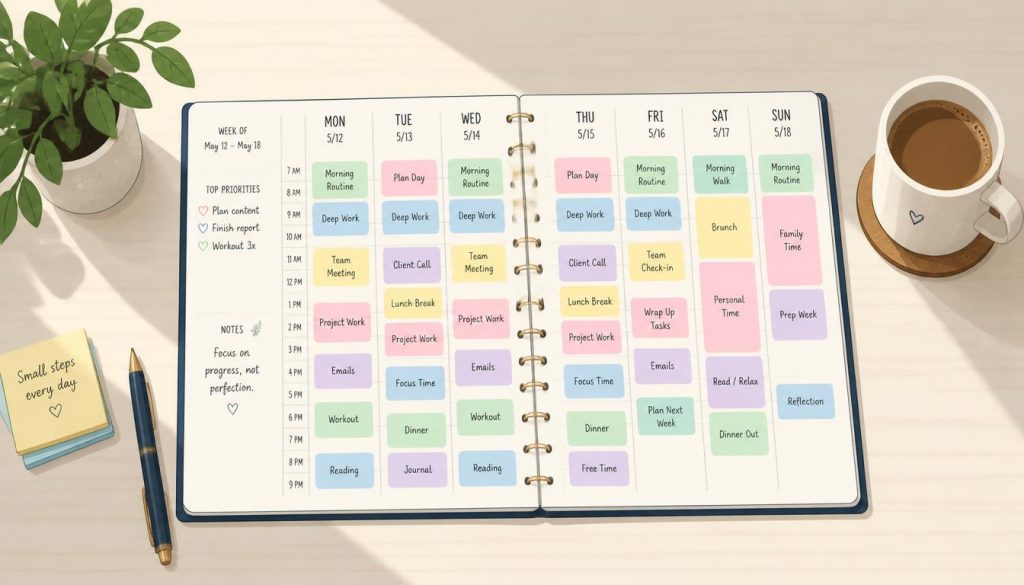
Time blocking means dividing your day into dedicated chunks, and assigning a specific task or category of tasks to each chunk. Instead of working through a vague to-do list and hoping you hit everything, you actually schedule your priorities into your calendar like appointments.
So instead of: “Today I need to respond to emails, write the report, prep for the meeting, and somehow exercise.”
It becomes:
- 8:00 AM to 9:00 AM: Morning routine and grounding (check out the morning routine for mental clarity guide for ideas here)
- 9:00 AM to 11:00 AM: Deep work on the report (Pomodoro rounds)
- 11:00 AM to 11:30 AM: Email batch
- 11:30 AM to 12:30 PM: Meeting prep
- 12:30 PM to 1:30 PM: Lunch and true rest
- 1:30 PM – 3:00 PM: Buffer / overflow / unplanned tasks
- 3:00 PM to 4:00 PM: Lighter tasks and admin
When your day has a shape, your mind has a structure to lean on. You’re not making dozens of micro-decisions about what to work on next. That decision fatigue is exhausting, and it steadily drains the mental energy you need for actual thinking.
How the Pomodoro Technique and Time Blocking Work Together
Here’s where the real magic happens.
Time blocking gives you your day’s structure. The Pomodoro technique gives you your focus strategy within each block. Together, they create a rhythm that most people describe as the first time work has ever felt manageable.
Think of time blocking as the architecture of your day and Pomodoro as the furniture inside each room. One builds the container. The other fills it with intention.
For example, if you block off 9 AM to 11 AM for deep work, you then run Pomodoro rounds within that block. Twenty-five minutes of focused writing, five-minute break, repeat. When 11 AM arrives, you close that block and move on. No guilt about what didn’t get done. No aimless drifting into the next thing. Clean transitions.
Real-Life Scenarios: What This Actually Looks Like
Scenario 1: The Overwhelmed Student
Maya is a college junior studying psychology. She has three assignments due, a part-time job, and a head full of anxious thoughts. Every time she sits down to study, she opens three tabs, checks Instagram, writes one sentence, and spirals.
She starts time blocking her Sunday afternoons for assignment planning. On weekdays, she uses the Pomodoro technique during her designated study blocks. Twenty-five minutes on her essay, five minutes to stretch and breathe. She’s not studying longer. She’s studying better. Her anxiety doesn’t disappear, but it has less room to run the show.
Scenario 2: The Work-From-Home Parent
Daniel works remotely and has two kids in the house during school breaks. His biggest struggle is context-switching between work brain and parent brain, often five times an hour. He never feels fully present in either role.
He uses time blocking to create non-negotiable work blocks when childcare is covered, and equally firm “closed laptop” blocks for family time. Within his work blocks, Pomodoro rounds help him maximize every available minute. He starts ending the day feeling like he actually finished something instead of half-finishing everything.
Scenario 3: The Burnt-Out Professional
Priya has been running on empty for months. She works in marketing, her to-do list never ends, and she stays late most evenings trying to catch up. She reads about the Pomodoro technique and thinks it sounds too simple to help.
She tries it anyway. The first thing she notices is that 25 minutes without her phone is harder than she expected. By day three, she notices her 10 AM Pomodoro is when she does her best thinking. She builds her time blocks around her natural energy peaks. Two weeks in, she is leaving on time, and the quality of her work is better than when she was grinding for ten hours straight.
If any of this sounds familiar, it’s worth reading more about what unaddressed pressure does over time at The Difference Between Stress and Burnout.
Scenario 4: The Creative Who Can’t Start
Jordan is a freelance graphic designer. The work is meaningful, but every project starts with a terrifying blank page and a swirling mind. Procrastination and perfectionism circle each other endlessly.
Jordan starts using Pomodoro rounds just for starting. The first 25-minute block isn’t about making something good. It’s just about making something. The timer gives permission to be imperfect within the round because the round ends and begins again. Over time, starting becomes less frightening because it’s just a 25-minute experiment, not a performance.
If perfectionism is what’s keeping you stuck before the timer even starts, the Mindbloom article on how to quiet mental chatter addresses exactly that inner loop.
Scenario 5: The Chronic Multitasker
Sasha has always been proud of multitasking. Three conversations, two documents, one call. But lately she’s been forgetting things, losing her train of thought mid-sentence, and feeling mentally exhausted by noon.
Research from the American Psychological Association confirms that task-switching dramatically reduces efficiency and increases error rates. Sasha starts using time blocking to batch similar tasks together and Pomodoro rounds to stay single-task focused within each block. Within two weeks, she’s doing less but finishing more.

The Mental Health Benefits Nobody Talks About
The Pomodoro technique and time blocking are usually framed as productivity tools. But their mental health benefits are just as significant, if not more so.
Reduced anxiety. When your day has a clear structure, your nervous system settles. Uncertainty and vagueness are anxiety fuel. A time-blocked calendar gives your brain something solid to stand on.
A sense of control. One of the most corrosive effects of chronic overwhelm is feeling like life is happening to you. Choosing how you spend your time, even in small ways, restores a sense of agency that is deeply connected to wellbeing.
Clearer boundaries between work and rest. When you know you’ve got a planned block for rest, you can actually rest. So many people struggle to switch off because work never officially ended. Time blocking creates endings. And endings create real recovery.
Less shame and guilt. The Pomodoro technique makes progress visible. Each completed round is a concrete achievement. For anyone struggling with anxiety or low self-esteem, these small, measurable wins genuinely matter.
If your mental noise runs especially deep, combining these techniques with practices that quiet the chatter can make a significant difference. The article on how to quiet mental chatter pairs beautifully with this approach.
According to research published in the National Library of Medicine, structured work habits and recovery breaks are directly linked to lower cortisol levels and improved cognitive performance. Your focus practice is, in a real way, a mental health practice.
Step-by-Step: Building Your Own Pomodoro and Time Blocking Routine
You don’t need to overhaul your life. You just need to start somewhere.
Step 1: Audit your current day
Before you build a new system, look at what’s actually happening. For one or two days, track what you’re doing in 30-minute chunks. You’ll likely find large gaps of unfocused activity and a few peak periods of genuine clarity.
Step 2: Identify your energy peaks
Most people have natural high-focus windows, usually in the morning, sometimes in late afternoon. Protect these windows for your most important, demanding work. Save admin, emails, and lighter tasks for lower-energy times.
Step 3: Block your day the night before
Spend five to ten minutes the evening before mapping out your next day’s blocks. Not every minute needs to be scheduled. Just your priorities. Leave buffer zones between blocks for transitions and the unexpected.
Step 4: Assign Pomodoro rounds to your deep work blocks
Within any block requiring focused thinking, use 25-minute Pomodoro rounds. Have a timer ready, whether it’s your phone, a kitchen timer, or a free app like Forest or Focus Keeper.
Step 5: Honor the breaks
This is where most people fail. The five-minute break is not optional. It’s not a reward. It’s part of the system. Step away from your screen. Walk to the window. Breathe. Let your brain reset before the next round.
Step 6: End your day with a shutdown ritual
At the end of your last block, take five minutes to capture anything unfinished, note what you accomplished, and close the day. This signals to your brain that work is over. It protects your evenings and helps you actually decompress.
If building a morning ritual alongside this feels overwhelming, starting small is the key. Morning routines for a clear mind offers gentle, realistic ways to ease into structure without adding pressure.
Common Mistakes (And How to Avoid Them)
Mistake 1: Treating every task as a Pomodoro task. Not everything needs timed focus. Pomodoro rounds work best for tasks requiring real concentration. Replying to a text or pouring coffee don’t need a timer.
Mistake 2: Over-scheduling. If every minute of your calendar is blocked, there’s no room for the unexpected, and there will always be unexpected. Aim to block 60 to 70 percent of your day, leaving the rest as buffer.
Mistake 3: Skipping the long break. After four Pomodoro rounds, take the longer 20 to 30-minute break. Seriously. This is when your brain consolidates information and recharges for the next set.
Mistake 4: Using Pomodoro rounds during creative brainstorming. Some creative thinking needs to meander. Rigid time pressure can kill the associative wandering that leads to breakthroughs. Save Pomodoro rounds for execution, not always for ideation.
Mistake 5: Giving up after one bad day. Any new habit feels awkward at first. One chaotic Tuesday doesn’t mean the system doesn’t work. It means you’re learning. Give it at least two full weeks before assessing.
What Science Says About Working in Focused Bursts
The science here is genuinely compelling.
The American Psychological Association reports that mental blocks created by task-switching can cost as much as 40 percent of productive time. Every time you bounce between tasks, your brain needs time to reload the context of the new task. Pomodoro rounds eliminate that cost within a work session.
A study referenced by the National Institute of Mental Health found that people with attention regulation difficulties show meaningful improvement in focus and task completion when given clear time boundaries and built-in recovery periods, exactly what the Pomodoro technique provides.
Research from the American Psychological Association further reinforces that cognitive performance deteriorates sharply without recovery periods — the brain is simply not built for unbroken, sustained effort.
And according to the American Institute of Stress, chronic workplace stress is directly tied to inability to prioritize and lack of control over one’s schedule. Time blocking directly addresses both of those root causes.
A Gentle Word If Structure Feels Scary
For some people, the idea of structuring their day feels rigid or even anxiety-inducing. If that’s you, you’re not alone.
Sometimes the resistance to structure comes from a fear of failure. If you schedule a block and don’t complete what you planned, it can feel like evidence that you’re not enough. But that’s not what structure is for. It’s a compass, not a verdict.
Start smaller than you think you need to. One Pomodoro round a day. One blocked hour in the morning. You’re not building a perfect system. You’re building a slightly less chaotic one. That’s enough to begin.
If anxiety and overwhelm run deeper than focus and productivity, understanding the bigger picture of what mental and physical stress do to the body can help too. The Body & Mind section on Mindbloom explores the connection between how we carry stress and how it shows up in everything we do.
Closing Thoughts: Your Focus Is a Form of Self-Respect
The Pomodoro technique and time blocking are not about squeezing more out of yourself. They’re about finally giving your energy somewhere intentional to land.
When you protect your focus, you protect your peace. When you create structure, you create space for the rest, the creativity, the presence that busyness so easily steals. Every 25-minute round you complete is a small act of showing up for yourself. Every block you honor is a quiet message to your own nervous system that you are in control of your day, not the other way around.
You don’t have to do this perfectly. You just have to start.
One timer. One task. Right now.
Frequently Asked Questions
1. What is the Pomodoro technique? The Pomodoro technique is a time management method that breaks work into 25-minute focused intervals, each followed by a short 5-minute break. After four intervals (called pomodoros), you take a longer break of 15 to 30 minutes. It was created by Francesco Cirillo in the late 1980s and remains one of the most widely used focus methods in the world.
2. How does the Pomodoro technique work step by step? Choose one task, set a timer for 25 minutes, and work on that task exclusively until the timer rings. Then take a 5-minute break. Repeat four times, then take a 15 to 30-minute longer break. Each 25-minute interval is one “pomodoro.” The method works by shrinking the scope of focus into a manageable, time-limited commitment — which dramatically reduces procrastination and mental fatigue.
3. What is time blocking and is it the same as scheduling? Time blocking is the practice of assigning specific tasks to dedicated chunks of time in your calendar. It’s more intentional than a basic schedule because you’re proactively protecting time for priorities rather than reacting to whatever comes your way throughout the day.
4. Can the Pomodoro technique help with anxiety? Yes, many people find it reduces anxiety by shrinking the scope of what they need to focus on. Instead of facing an overwhelming project, you only need to commit to the next 25 minutes. This makes starting much easier and reduces the dread that anxious minds often attach to large tasks.
5. How many Pomodoro rounds should I do in a day? Most people find eight to twelve rounds (four to six hours of actual focused work) to be sustainable over the long term. Quality of focus matters more than quantity of rounds. It’s better to complete six excellent rounds than push through twelve poor ones.
6. What if I get interrupted during a Pomodoro round? Cirillo’s original approach suggests noting the interruption and continuing. If the interruption is unavoidable (a child, an emergency), restart that round from the beginning when you return. Over time, people around you tend to learn your focus windows if you communicate them clearly.
7. Is time blocking good for people with ADHD? Time blocking can be genuinely helpful for people with ADHD when combined with flexibility. Rigid schedules can increase anxiety, but having a loose visual structure for the day reduces decision fatigue, which is a real challenge for ADHD brains. The Pomodoro technique’s short windows are also well-suited to attention regulation challenges.
8. Do I need a special app to use the Pomodoro technique? No. A kitchen timer, your phone’s clock app, or any basic countdown timer works perfectly. Apps like Forest, Focus Keeper, or Be Focused add visual motivation and tracking if you want them, but they’re not necessary to get started.
9. How do I handle deep work that takes longer than 25 minutes? You don’t stop in the middle of a complex thought just because the timer rings. The timer is a guide, not a dictator. If you’re deep in flow, add five more minutes and finish your thought before breaking. The purpose of the timer is to help you start and sustain, not to interrupt meaningful momentum.
10. Can I use time blocking and Pomodoro together? Absolutely, and they work exceptionally well together. Time blocking gives your day a structure and protects time for priorities. Pomodoro rounds give you a focus strategy within each block. They address different layers of the same problem: what you do with your time, and how you actually show up inside it.
11. What’s the biggest mistake people make with time blocking? Over-scheduling. When every minute is assigned, there’s no room for error or the unexpected, and the entire system feels suffocating. Block your key priorities and leave at least 30 percent of your day as buffer. This makes the system sustainable, not stressful.
A Personal Question for You
You made it all the way here, which tells me something. Maybe a part of you is tired of feeling busy but scattered. Maybe you’ve tried to focus a hundred times and watched another afternoon disappear.
Here’s what I want to ask you:
Here’s a small challenge: name the one task you’ve been avoiding in the comments below — and then set a 25-minute timer right after you post it. You don’t have to finish it. You just have to start. Come back and tell me how it went.
It’s safe to say it here. This space is for exactly that kind of honesty.
Disclaimer
This article is written for informational and personal growth purposes only. It does not constitute professional medical, psychological, or therapeutic advice. The Pomodoro technique and time blocking are productivity tools, not treatments for clinical conditions. If you are experiencing significant mental health challenges, please consult a qualified mental health professional. Mindbloom is a personal blog and is not a substitute for professional care.