
Grieving the Loss of a Loved One: The Honest Truth About Grief Nobody Prepares You For

Grieving the loss of a loved one doesn’t arrive the way anyone warns you it will. One moment you are standing in a grocery store reaching for their favorite cereal, and the next you can’t breathe. The world keeps spinning. But yours has stopped. This is grief — not the cleaned-up version you read about in pamphlets, but the disorienting, shape-shifting, body-level grief that nobody fully prepares you for. And yet, you are not alone in it. Millions of people are quietly carrying exactly what you are carrying right now.
You have probably heard it all — “give it time,” “they’re in a better place,” “stay strong.” And maybe a part of you wanted to throw something, because none of those words came anywhere close to the weight you are actually carrying. This guide isn’t going to do that to you. Instead, it’s going to walk honestly through what grieving the loss of a loved one actually looks like — the contradictions, the physical toll, the moments that blindside you three years later — and offer real, human ways to cope with losing someone you love without pretending it’s simple.
Whether your loss happened last week or three years ago and still quietly breaks you, what you are feeling is valid. You are not broken. You are grieving. And there is a difference.
Table of Contents
What Grieving the Loss of a Loved One Actually Feels Like
Most people know grief as sadness. Heavy, tearful, unmistakable sadness. But grief is actually a shape-shifter. It does not arrive in a neat progression and it does not stick to one feeling.
You might feel profound sadness that comes in waves and then, without warning, anger so sharp it startles you. You might feel nothing at all for stretches of time, which can be just as frightening as the pain itself. You might laugh at something and then immediately feel guilty for laughing. You might sleep for twelve hours or not sleep at all. You might reach for your phone to call them before you remember.
All of this is grief. Every last confusing, contradictory piece of it.
Here are some of the things people rarely warn you about:
Grief lives in the body, not just the mind. Physical symptoms of grief are extremely common and include chest tightness, headaches, fatigue that no amount of rest fixes, appetite changes, a feeling of hollowness in the stomach, and even a weakened immune system. According to the American Psychological Association, grief can manifest as a full-body physical response, not merely an emotional one.
Grief has no expiration date. The idea that you should “be over it” by a certain point is one of the most damaging myths in our culture. Research published by the Mayo Clinic confirms that grief timelines vary dramatically from person to person, and that comparing your process to someone else’s is not only unhelpful but genuinely harmful.
Grief can look like anger, numbness, or even relief. If your loved one suffered for a long time before passing, relief is a natural feeling. It does not mean you loved them less. It means you are human.
Real Experiences of Grieving: You Are Not as Alone as You Feel
Sometimes the most healing thing is knowing that what you are feeling is not uniquely broken. It is deeply, universally human.
Sarah, 34, lost her mother to cancer: She said the hardest part was not the funeral. It was three months later, standing in the cereal aisle at the grocery store, when she reached for her mom’s favorite brand out of habit and then stood there, unable to move, for what felt like forever. “Grief ambushed me in the most ordinary places,” she said. “I wasn’t prepared for that.”
Marcus, 52, lost his best friend suddenly: He went back to work within a week because he did not know what else to do with himself. He described feeling like he was “wearing a mask of okay” for months. At night, when the mask came off, the pain was almost unbearable. “I kept thinking I should be handling this better,” he said. “Nobody told me that ‘handling it’ was allowed to look like falling apart.”
Priya, 28, lost her grandmother who raised her: She described feeling guilty for moving forward — for smiling, for going on a trip, for dating again. “Every time I felt happy, there was this voice saying I shouldn’t be. Like moving forward meant forgetting her.”
Elena, 61, lost her husband of 30 years: She found herself talking to him for the first six months. Out loud. At dinner. Asking him what he thought about things on the news. “People would have thought I was losing my mind,” she laughed softly. “But it helped. It kept him close a little longer.”
James, 19, lost his older brother: He didn’t cry at the funeral. He didn’t cry for two years. Then one night, watching a basketball game — his brother’s favorite — something broke open. “I thought I was fine. I wasn’t fine. I just hadn’t found the door yet.”
Every one of these people found their way through. Not over, not past — through. And so will you. What helped each of them wasn’t a timeline or a formula — it was understanding that grief doesn’t follow rules. And that’s exactly what the next section is about.
Why Grief Is Not Linear (And Why That’s Okay)
You may have heard of the five stages of grief — denial, anger, bargaining, depression, and acceptance — and if you’ve been wondering why your grief doesn’t look like a neat checklist, it’s because that model was never meant to be a roadmap. If you’d like to explore those stages more deeply, the full breakdown of the 5 stages of grief goes through what they actually feel like from the inside — because reading about them and living through them are two entirely different things.
Grief cycles. It doubles back. It skips stages entirely and revisits others. You can reach a point of genuine peace and then hear a song, smell a certain cologne, or see their handwriting on an old birthday card and feel like you are right back at the beginning.
This is not a setback. This is the nature of love. The depth of your grief is, in a very real way, a measurement of the love you shared. And love does not expire.
The Difference Between Grief and Depression
This is an important distinction — because while grief and depression can look similar from the outside, they are not the same thing, and treating one like the other can cause real harm.
Grief is a natural, healthy response to loss. It comes in waves. There are moments of relief and even joy woven between the pain. It tends to decrease in intensity over time, even if it never fully disappears.
Depression is a clinical condition that requires professional support. It is more persistent, pervasive, and does not lift even temporarily. It affects your ability to function, to find any meaning at all, and can include thoughts of self-harm or hopelessness that go beyond grief.
According to the National Alliance on Mental Illness (NAMI), what is sometimes called “complicated grief” — where normal grieving becomes prolonged and debilitating — affects roughly 7% of bereaved people and may require specialized therapy.
If you are unsure whether what you are experiencing has moved beyond typical grief, please reach out to a mental health professional. There is no shame in needing that support. In fact, knowing when to ask for help is one of the bravest things you can do — and if you have been thinking about what that actually looks like, exploring the different types of therapy can help you understand which approach might feel right for where you are.
If any of these feel true for you, it may be time to reach out to a professional — and that is a courageous thing, not a weak one:
- Persistent inability to perform daily functions weeks or months after the loss
- Intense, prolonged guilt or self-blame
- Feeling that life has no purpose without the person
- Thoughts of harming yourself or not wanting to be alive
- Substance use as a way of numbing the pain
How Suppressed Grief Affects Your Body and Mind
One of the most common things people do when grieving is try to hold it together. To be strong. To not burden others. To keep functioning.
And while there are absolutely moments when we need to contain our emotions temporarily — at work, in public, while taking care of children — chronic suppression of grief takes a real toll.
When you consistently push grief down instead of allowing it to move through you, it tends to find other ways out. This can show up as irritability, emotional numbness, disconnection from people you love, physical tension, or a vague but persistent sense of anxiety that you cannot explain. The relationship between suppressed emotions and the body is something worth understanding deeply, and if you have ever wondered why your body feels like it is holding something even when your mind says you are fine, this piece on the effects of suppressed emotions on the body explains exactly what happens physiologically when we hold grief in instead of letting it out.
Crying is not weakness. Falling apart is not failure. Letting yourself feel grief — really, fully feel it — is the only path through it.
What Grieving the Loss of a Loved One Does to Your Sleep
One of the least discussed but most universally felt side effects of grief is what it does to your sleep. Many people experience insomnia after a loss, lying awake replaying memories, imagining final conversations, catastrophizing the future without this person in it. Others sleep far too much, using sleep as an escape from a reality that feels unbearable.
Both are normal grief responses.
Your nervous system has experienced a significant shock. It is in a heightened state of alert, processing something it does not fully know how to process. This directly impacts your ability to fall and stay asleep.
According to Harvard Health Publishing, sleep disruption is one of the most common physical manifestations of acute grief, and addressing it gently — rather than forcing yourself to “sleep normally” — is essential for your overall healing.
Some gentle things that may help your sleep during grief:
- Keeping a brief nightly journal to offload circling thoughts before bed
- Allowing yourself to leave a light on, play soft music, or make your sleep environment feel less empty
- Not forcing yourself to lie in the dark if it feels unbearable
- Moving your body gently during the day to release some of the physical tension of grief
- Being patient with yourself — this is not a sleep problem, it is a grief response

Practical Ways to Carry Your Grief Without Being Crushed by It
Healing from grief is not about getting over it. It is about learning to carry it differently. Over time, what starts as a wound that takes up your whole body gradually finds a place to live within you — present, but no longer consuming everything.
Here are some genuinely helpful, human approaches to moving through grief:
1. Schedule Time to Grieve — It Actually Helps
Give grief a container instead of forcing it underground. This might mean setting aside 15 to 20 minutes a day — what some grief counselors call a “grief window” — to intentionally feel. Cry, journal, look at photos, say their name out loud. Then gently return to your day. This helps your nervous system process grief incrementally rather than having it ambush you constantly.
2. Say Their Name Out Loud — It Matters More Than You Think
One of the things grieving people fear most is that others will stop mentioning their loved one’s name. Speak their name. Share memories. Let them remain part of conversations. Research consistently shows that being able to speak about the deceased helps integrate the loss rather than pretend it did not happen.
3. Find Someone Who Will Just Be Present With You (Not Fix You)
Not fix you. Not advise you. Just sit with you. This might be a friend, a family member, a grief support group, or a therapist. Isolation amplifies grief. Connection does not take the pain away but it makes it far more survivable.
4. Move Your Body — Grief Lives in Your Muscles Too
Grief is held in the body. Walking, stretching, yoga, swimming — any gentle movement helps release some of the physical weight. You do not need to “exercise.” You just need to move. Even a fifteen-minute walk outside can interrupt the spiral.
5. How to Handle Unhelpful Comments From Well-Meaning People
Well-meaning people will say things like “at least they lived a long life” or “everything happens for a reason” or “you need to be strong for your kids.” These comments, however intended, can be deeply unhelpful. You are allowed to set a gentle limit: “I know you mean well, and I’m just not in a place for that right now. I just need to feel what I feel.”
6. Stop Letting Others Put a Timeline on Your Grief
You do not need to clear out their belongings by a certain date. You do not need to stop wearing your wedding ring. You do not need to be “back to normal” by any deadline. Grief has its own clock and it does not answer to anyone else’s comfort level.
7. Create a Small Ritual to Honor Them — It Transforms the Pain
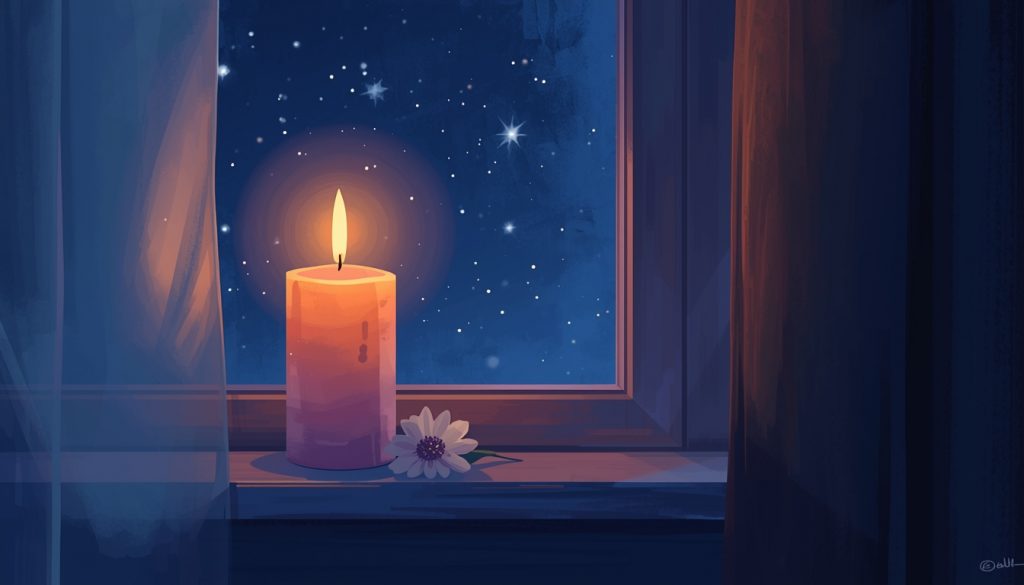
Light a candle on their birthday. Cook their favorite meal on an anniversary. Write them a letter you never send. Plant something in their memory. Rituals give grief structure and meaning. They transform loss from something that happens to you into something you actively hold with love.
8. Know That Growth Can Coexist With Grief
This one takes time. But many people who have moved through profound loss describe an eventual deepening — of empathy, of presence, of what matters. This is sometimes called post-traumatic growth, and it does not mean the loss was worth it. It means you are resilient in ways you may not yet know.
When Grief Arrives in Waves: The Dual Process Model
One framework that many grief therapists use — and that many grieving people find genuinely helpful — is the Dual Process Model, developed by researchers Stroebe and Schut. Rather than a linear progression, it suggests that healthy grieving involves oscillating between two orientations.
The first is “loss orientation” — actively grieving, feeling the pain, processing the absence. The second is “restoration orientation” — attending to the life changes that come with loss, taking breaks from grief, rebuilding.
Healthy grieving, according to this model, is not about staying in the pain or avoiding it. It is about moving between both. On some days you cry. On other days you go for a walk and feel something close to ordinary. Both are valid. Both are necessary.
Giving yourself permission to laugh, to rest, to enjoy something — these are not betrayals. They are part of healing.
Grieving When Others Don’t Understand Your Loss
Not all grief is treated equally by the world around us. The loss of a pet, a pregnancy, a friendship, an estranged parent, a public figure who meant deeply to you — these losses are sometimes minimized or dismissed. This is sometimes called “disenfranchised grief,” and it is just as real and just as deserving of space.
If you find yourself grieving a loss that others do not fully validate, please know: your pain does not need external permission to be real. Grief exists wherever love existed. Full stop.
Moving Forward Without Forgetting: What Healing Really Looks Like
Healing from loss does not mean you no longer miss them. It does not mean the grief disappears. It means the grief transforms. It means you can hold their memory with more warmth than ache. It means you can build a future that honors them even in their absence.
People who have moved through profound grief often describe carrying their loved one forward — integrating them into who they are becoming rather than leaving them behind. Their influence, their values, the way they laughed, the things they taught you — these do not disappear with a body. They live on in you.
You are still here. You are still becoming. And the love that exists between you and the person you lost? That exists outside of time.
A Short Closing: For You, Right Now
If you are in the thick of grief right now, this is for you.
You do not have to be strong. You do not have to hold it together. You do not have to understand why or find the silver lining today. You just have to survive today. And tomorrow, you just have to survive tomorrow.
Grief is not a problem to be solved. It is love with nowhere left to go. And with time, with support, with gentleness toward yourself, you will learn how to carry it. Not as a burden, but as a testament to something that mattered.
You are not alone in this. You were never alone in this.
Frequently Asked Questions About Grieving the Loss of a Loved One
1. How long does grieving the loss of a loved one last? There is no set timeline. Grief is deeply personal and varies widely depending on the relationship, the circumstances of the death, your support system, your mental health history, and many other factors. Some people experience acute grief for months; for others it lasts years. What typically changes over time is not that grief disappears, but that it becomes less all-consuming and easier to carry.
2. Is it normal to feel nothing after losing someone? Yes. Emotional numbness is a very common early response to loss and is actually a protective mechanism. Your mind and body can go into a kind of shock after a significant loss. Feeling nothing, going through the motions, or feeling strangely calm in the immediate aftermath is not a sign that you didn’t care — it is a sign that your nervous system is managing an overwhelming experience.
3. What is complicated grief and how do I know if I have it? Complicated grief (also called prolonged grief disorder) is when the symptoms of acute grief persist at high intensity for more than twelve months after the loss and significantly impair daily functioning. Signs include intense longing that does not lessen, inability to accept the death, bitterness or anger related to the loss, and difficulty engaging in life. It is a recognized condition and responds well to specialized therapy.
4. Can grief make you physically sick? Yes. Grief places significant stress on the body and immune system. Research has linked acute grief to increased risk of cardiovascular problems (sometimes called “broken heart syndrome”), immune suppression, sleep disorders, fatigue, and digestive issues. Taking care of your body during grief — eating, moving gently, sleeping as best you can — is not a luxury, it is essential.
5. What is the hardest part of grieving the loss of a loved one? Most people expect the funeral or the first few weeks to be the hardest. And they are — but many grievers report that the weeks and months after the initial outpouring of support ends are often more difficult. The phone stops ringing. People return to their lives. And you are left alone with a loss that hasn’t shrunk, in a world that expects you to be getting better. The “secondary losses” — the routines, the roles, the future you imagined — can surface long after the initial shock fades. Knowing this doesn’t make it easier, but it helps you stop questioning whether something is wrong with you when grief resurges unexpectedly.
6. How do I help someone who is grieving the loss of a loved one? The most important thing you can do is show up without an agenda. Do not try to fix their grief or offer silver linings. Instead, say “I love you and I’m here.” Bring food. Sit in silence if that’s what they need. Mention the person who died by name — most grieving people desperately want to hear their loved one spoken about. Follow their lead and resist the urge to say “let me know if you need anything” — they likely won’t ask. Just come.
7. Is it okay to feel relieved after someone dies? Absolutely. Relief after loss — especially when the person suffered, or when the relationship was difficult — is a completely normal and human response. Feeling relief does not mean you did not love them or that you are glad they are gone. It often means you are relieved their suffering is over, or that a prolonged, painful chapter has ended. Allow yourself to feel this without guilt.
8. Why do I feel angry at the person who died? Anger is one of the most confusing — and common — aspects of grief. You might feel angry at the person for leaving, for not taking better care of themselves, for choices they made, or simply because the anger is easier to feel than the unbearable sadness underneath it. This anger is valid. It does not make you a bad person. It makes you a person in pain.
9. Should I go back to work while grieving? This is very personal. Some people find that returning to work quickly gives them structure and a sense of normalcy that helps. Others find it unbearable and need more time. There is no right answer. If possible, give yourself whatever space you genuinely need. If returning to work is necessary, it is okay to set quiet limits with colleagues about your capacity and to allow yourself small private moments to feel.
10. How do I talk to children about the death of a loved one? Children need age-appropriate honesty. Avoid euphemisms like “went to sleep” or “passed away” which can create confusion or fear. Use clear, gentle language: “Grandma died, which means her body stopped working and she won’t be with us anymore.” Allow them to ask questions, express emotions, and be part of mourning rituals in age-appropriate ways. Reassure them that they are safe and loved, and watch for changes in behavior that might indicate they need additional support.
10. Will I ever feel like myself again after losing someone? Yes. Not immediately, and possibly not in the exact same way — because profound loss does change us. But most people who have moved through grief describe eventually arriving at a place where joy is possible again, where life has meaning again, where they can hold their loved one’s memory with love rather than only pain. You may be a different version of yourself. But you will be okay. Millions of people who once felt exactly as you do right now are living proof of that.
Where are you right now in your grief? You don’t have to have answers — just share one true thing you’re feeling or one moment that surprised you. This space is genuinely safe, and you will be heard.
Disclaimer
The content on Mindbloom is written from personal lived experience and is intended for general informational and supportive purposes only. It is not a substitute for professional mental health advice, diagnosis, or treatment. If you are experiencing a mental health crisis, prolonged grief disorder, or thoughts of self-harm, please reach out to a qualified mental health professional or a crisis helpline. You can find support resources at Befrienders Worldwide.