
Stress vs. Burnout: Key Differences, Signs, and How to Recover

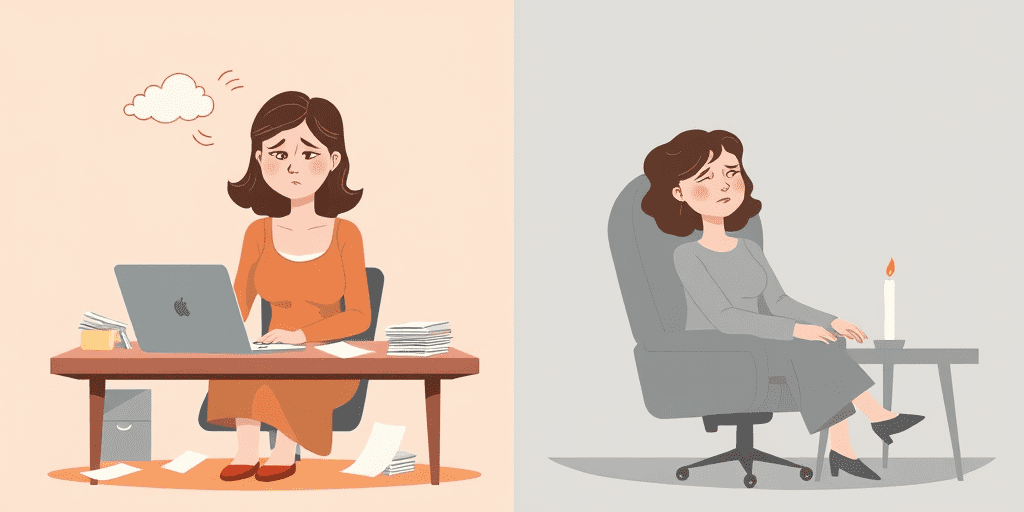
You keep telling yourself it’s just a rough patch.
That once you get through this deadline, this season, this year — things will settle down. You’ll finally feel like yourself again. You’ll sleep better, laugh more, stop snapping at the people you love.
But the rough patch has been going on for a while now. And lately, even the thought of starting a new week feels like lifting something impossibly heavy.
Here’s what nobody tells you early enough: there’s a significant difference between stress and burnout — and treating the wrong one doesn’t just slow your recovery. It can actively make things worse. You can’t recover from burnout the way you recover from stress. And you can’t manage stress the way you’d manage full-blown burnout.
Understanding the difference between stress and burnout isn’t just an intellectual exercise — it’s the first step toward actually getting better.
Table of Contents
What Is Stress? Signs, Symptoms, and What It Actually Feels Like
Before you can understand burnout, you need to recalibrate your relationship with stress — because stress itself isn’t the enemy. Chronic, unrelieved stress is. In fact, some stress is what gets you through a presentation, pushes you to finish a project, or helps you respond quickly in a tough situation.
Stress is your body’s natural response to a perceived challenge or demand. Your nervous system kicks into gear, your heart rate increases, cortisol floods your system, and you become sharper and more focused. It’s the biological equivalent of your body saying, “Something needs your attention — let’s go.”
The problem isn’t stress itself. The problem is when stress becomes chronic — when the demands never let up, when there’s no recovery time built in, and when your nervous system never gets the signal that the threat has passed.
Signs You’re Dealing With Stress
Here’s what stress typically looks like in real life:
- You feel overwhelmed, but you still care deeply about the things overwhelming you
- You’re worried about the future but still feel engaged with life
- You feel urgency — like there’s too much to do and not enough time
- Your sleep is disrupted, but on a good weekend, you can bounce back
- You feel emotionally reactive, but you understand why
- When you imagine the pressure being removed, you feel relief
That last point is important. With stress, the light at the end of the tunnel still feels reachable. You can picture what “better” looks like, even if it feels far away.
What Is Burnout? How It Differs From Stress — and Why It’s Harder to Recover From
Burnout is what happens when chronic stress goes unaddressed for too long.
It was officially recognized by the World Health Organization in 2019 as an occupational phenomenon — not a lifestyle choice, not a personal failure, and definitely not something you can just push through. According to the WHO, burnout is characterized by three core dimensions: exhaustion, mental distance or cynicism, and reduced professional efficacy.
In plain terms? You’ve stopped caring. Not because you’re lazy, but because your nervous system has run completely out of resources to give.
Signs You’re Experiencing Burnout
The difference between stress and burnout becomes clearest when you look at how each one feels on the inside:
- You feel empty rather than overwhelmed — like there’s simply nothing left
- Tasks that used to engage you feel meaningless or pointless
- You feel detached from your work, your relationships, and sometimes yourself
- Rest doesn’t help — you can sleep for ten hours and still wake up exhausted
- You feel cynical, bitter, or emotionally numb in situations where you’d normally feel something
- When you imagine the pressure being removed, you don’t feel relief — you feel nothing
That last point is the gut-punch. Burnout doesn’t respond to a long weekend or a vacation the way stress does. Why? Because burnout isn’t just tiredness — it’s a depletion that goes all the way to your core.
Research published by Harvard Business Review highlights that burnout often creeps in gradually, which is exactly why so many people miss it until they’re completely depleted.
Real-Life Scenarios: Stress vs. Burnout in Action
Let’s make this concrete with some everyday examples, because theory only goes so far.
Scenario 1: The Teacher
Maya has been teaching for six years and loves it. This semester, she’s dealing with a difficult class, a pile of administrative paperwork, and a curriculum overhaul all at once. She’s exhausted, crying a little too often, and dreaming about summer.
But when one of her students has a breakthrough moment in class? Maya still feels that spark. She’s still sending funny teacher memes to her colleagues. She’s stressed — and she needs support, rest, and probably some very strong coffee.
Now imagine Maya in year nine. She no longer feels anything when a student succeeds. She’s stopped decorating her classroom. She dreads Sunday evenings with a heaviness that doesn’t lift. She’s not behind on paperwork because she’s busy — she just can’t make herself care anymore.
That’s burnout.
Scenario 2: The Marketing Manager
Daniel works in a fast-paced agency. His team is small, his clients are demanding, and he’s been working late almost every night. He’s tense, irritable, and struggling to sleep — but he still brainstorms ideas in the shower and feels proud when a campaign lands well.
Stressed? Absolutely. Burnt out? Not yet.
But six months later, Daniel has stopped offering ideas in meetings. He’s started calling in sick just to have a day where nobody needs him. He resents the work he used to love. His manager notices he’s “checked out.” Daniel doesn’t even have the energy to be offended by that observation.
That’s burnout.
Scenario 3: The Stay-at-Home Parent
Sarah manages the home, the kids’ schedules, the grocery runs, and the emotional climate of a busy household. She feels pulled in too many directions and fantasizes about an hour alone in silence.
When she gets that hour? It helps. She comes back feeling more like herself.
Stress.
But after years of this with no recognition, no relief, and no support — Sarah stops feeling the pulls entirely. She goes through the motions. She doesn’t fantasize about peace anymore, because even imagining better feels like too much effort.
Burnout.
Scenario 4: The Remote Worker
James started working from home during the pandemic and never went back. The lines between work and personal time dissolved completely. He’s always available. His laptop is always open. His to-do list never ends.
He’s stressed, but he’s still functional. He finishes tasks. He shows up to video calls. He wants to do good work.
A year into this pattern, James finds himself staring at his screen for twenty minutes at a time without typing a word. He no longer knows why he’s doing any of this. He feels like a ghost in his own life.
Burnout.
Why the Difference Between Stress and Burnout Changes How You Recover
Here’s why the difference between stress and burnout isn’t just semantic — it changes everything about how you approach recovery.
If you’re stressed and treat it like burnout, you might disengage from your responsibilities before you need to, lose momentum, or miss an opportunity to put better systems in place.
If you’re burnt out and treat it like stress, you keep pushing — which is the worst thing you can do. More effort, more hustle, more “just getting through it” accelerates depletion and can lead to serious physical and mental health consequences.
The American Institute of Stress notes that chronic stress and burnout both have measurable physical effects, including elevated blood pressure, immune suppression, and increased risk of heart disease. But burnout carries an additional layer: profound psychological disconnection that doesn’t respond to standard stress-management techniques.
You can’t meditate your way out of burnout. You can’t just “take a break.” Real burnout recovery requires something deeper: time, structural changes, professional support, and a complete reevaluation of how you’ve been living.
Understanding where you are on this spectrum allows you to get the right kind of help.
How Burnout Develops: The Stages You Might Be Moving Through
Burnout doesn’t arrive overnight. It moves through recognizable stages, first described by psychologists Herbert Freudenberger and Gail North. Understanding where you might be can help you intervene earlier.
Stage 1 – The Honeymoon Phase: You’re motivated, driven, and taking on more than is sustainable. Everything feels manageable — even exciting.
Stage 2 – The Onset of Stress: You start noticing the demands. Sleep suffers. Small tasks feel bigger than they should. You’re still functioning, but it’s getting harder.
Stage 3 – Chronic Stress: Stress becomes your baseline. Procrastination sets in. Resentment shows up. You start withdrawing from people and activities you used to enjoy.
Stage 4 – Burnout: This is the stage most people mean when they say they’re ‘burnt out,’ though many reach it without realizing it has a name. You feel hollow rather than tired. Tasks you once found meaningful feel pointless. You may go through the motions at work and at home, but something essential has gone offline. Physical symptoms now demand attention — chronic headaches, digestive disruption, a fatigue that sleep doesn’t touch. You’re not lazy. You’re running on empty.
Stage 5 – Habitual Burnout: This becomes your “normal.” You may not even recognize it as burnout anymore. It just feels like who you are now.
If any of this resonates, it’s worth exploring whether seeing a therapist might be the right next step. Burnout — especially in its later stages — almost always benefits from professional guidance.
Practical Steps: What to Actually Do Based on Where You Are
If You’re Stressed
The goal with stress is to interrupt the cycle before it becomes chronic. Here’s where to start:
1. Audit your plate honestly. What on your list genuinely needs to be there? What have you inherited out of habit, people-pleasing, or fear? Getting intentional about your commitments is essential — and so is setting boundaries at work without guilt.
2. Prioritize physical recovery. Your body carries stress whether you acknowledge it or not. Sleep, movement, and nutrition aren’t luxuries — they’re the foundation of resilience. If you’re waking up tired even after a full night, something is off in the recovery cycle.
3. Create micro-boundaries. You don’t have to overhaul your entire life. Start with small protective choices: no phone for the first thirty minutes of the morning, lunch away from your desk, one evening a week that’s genuinely yours. If workplace demands feel impossible to push back on, there are practical strategies for managing workplace stress and deadlines without burning out.
4. Talk to someone. Stress thrives in isolation. Whether that’s a trusted friend, a partner, or a professional, sharing what you’re carrying reduces its weight.
5. Use grounding when overwhelm spikes. When stress peaks and you’re spiraling, getting back into your body helps. Simple grounding techniques for work anxiety can interrupt the panic cycle and bring you back to the present moment.
If You’re Burnt Out
Recovery from burnout is slower, more deliberate, and requires a fundamentally different approach.
1. Stop trying to push through. This is counterintuitive for high-achievers, but effort makes burnout worse. Recovery begins the moment you stop treating depletion like a problem to overcome and start treating it like information your body is giving you.
2. Rest — but understand that rest will feel useless at first. Early in burnout recovery, rest doesn’t feel restorative. That’s not a sign it isn’t working. It’s a sign you need more of it. If rest doesn’t feel restorative, you’re likely dealing with burnout rather than ordinary tiredness.
3. Remove or reduce stressors at the source. Where possible, change the conditions that caused burnout. This might mean a conversation with your manager, reducing your workload, stepping back from responsibilities, or making more significant life changes. Burnout doesn’t just need bandages — it needs surgery.
4. Reconnect with something small that you used to love. Not productivity. Not self-improvement. Just something that feels, even slightly, like you. A walk. A playlist. A book for pleasure. Burnout disconnects you from yourself — healing reconnects you, one small thread at a time.
5. Seek professional support. Research from the Mayo Clinic consistently shows that burnout often requires therapy, medical evaluation, and sometimes medication — not willpower. Knowing when to ask for help isn’t weakness. It’s wisdom.
Burnout vs. Depression: Understanding the Overlap
Burnout and depression share many overlapping symptoms — emotional numbness, fatigue, withdrawal, loss of motivation. The key difference is that burnout tends to be context-specific (usually tied to work or caregiving demands), while depression permeates all areas of life.
That said, unaddressed burnout can absolutely develop into clinical depression. According to research published in PLOS ONE, there is significant overlap between burnout and depressive disorders, and the two can co-occur.
If your symptoms are severe, persistent, or accompanied by hopelessness, inability to function, or thoughts of harming yourself, please don’t wait. Reach out to a mental health professional, contact the 988 Suicide and Crisis Lifeline (call or text 988 in the US), or go to your nearest emergency room. Understanding the difference between stress and burnout is a useful tool — but it is never a substitute for professional care when you are in crisis. Understanding the difference between stress and burnout is valuable — but it’s not a substitute for proper clinical care.
You’re Not Weak. You’re Depleted.
Here’s what we want you to hold onto.
The fact that you’re reading this — that you’re trying to understand what’s happening to you, that you haven’t just accepted this as “the way life is” — says something important about you. You still believe things can be different. That part of you is right.
Burnout is not a character flaw. Stress is not a sign that you can’t handle life. These are human experiences, happening to genuinely capable, caring, hardworking people in a world that demands too much and offers too little support.
The difference between stress and burnout matters not because it changes how worthy you are of care — you’re worthy either way — but because it changes the path back to yourself.
And there is always a path back. If you’re not sure where you are on the stress-burnout spectrum, start with one honest question: when you imagine the pressure lifting, do you feel relief — or nothing at all? That answer matters more than you might think. And if you’re ready to take a next step, exploring when to see a therapist is a good place to start.
Frequently Asked Questions
1. What is the main difference between stress and burnout? Stress is usually temporary and tied to specific demands — it’s often resolved when the pressure lifts. Burnout is a state of chronic depletion caused by long-term, unaddressed stress. The key distinction is that with stress, you still feel motivated and engaged; with burnout, you feel empty and disconnected, even when the pressure eases.
2. Can you have both stress and burnout at the same time? Yes. Many people experience high stress while also showing signs of burnout. In fact, burnout often develops as a result of prolonged stress, so the two can overlap significantly — especially in the middle stages of burnout progression.
3. How long does it take to recover from burnout? Recovery varies widely depending on how severe the burnout is, how much the underlying causes can be addressed, and what kind of support is available. Some people begin to feel better within a few weeks of genuine rest and reduced demands. Others may need several months — or longer — especially if burnout has progressed into depression or other health issues.
4. Is burnout an official medical diagnosis? Burnout is recognized by the World Health Organization as an occupational phenomenon in the International Classification of Diseases (ICD-11), but it is not classified as a medical condition in itself. However, it can lead to or co-occur with diagnosable mental and physical health conditions.
5. What does burnout physically feel like in the body? Burnout often shows up physically as persistent fatigue that doesn’t improve with sleep, frequent headaches, muscle tension, digestive problems, lowered immunity (getting sick more often), and sometimes heart palpitations. The body keeps the score, and burnout is no exception.
6. Can burnout happen outside of work — like in parenting or caregiving? Absolutely. While burnout is most commonly discussed in occupational contexts, it can occur anywhere demands are consistently high and recovery is consistently low — including parenting, caregiving, relationships, and even creative pursuits. “Caregiver burnout” and “parental burnout” are recognized and documented phenomena.
7. How do I know if I need a therapist for burnout or just more rest? If rest doesn’t help — if you’re still feeling numb, empty, or disconnected after taking time off — that’s a strong signal that professional support would be valuable. A therapist can help you identify the root causes of burnout, process the emotional weight, and build sustainable recovery strategies.
8. Can going back to the same job make burnout worse? Yes, if the conditions that caused burnout remain unchanged. Returning to the same environment, demands, or dynamics without structural changes often results in re-burning out — sometimes faster the second time around. Recovery needs to address the source, not just the symptoms.
9. Is burnout more common in certain professions? Burnout rates tend to be higher in healthcare, education, social work, law enforcement, and high-pressure corporate environments — any field where demand is high, emotional investment is required, and autonomy or support is low. However, burnout can occur in any role, at any level.
10. What’s the single most important thing I can do if I think I’m burnt out? Stop. Seriously — the most important first step is to stop trying to push through. Acknowledge what’s happening. Then, if possible, reduce your most significant stressors immediately and reach out for support — whether that’s a trusted person in your life or a mental health professional. Burnout worsens with continued exertion and improves with genuine relief.
Disclaimer
The content on Mindbloom is intended for informational and educational purposes only. It is not a substitute for professional medical advice, diagnosis, or treatment. If you are experiencing symptoms of burnout, depression, anxiety, or any other mental health condition, please consult a qualified healthcare professional or licensed therapist. In a crisis, contact the 988 Suicide and Crisis Lifeline by dialing or texting 988 (USA). The Mindbloom Team writes from lived experience and personal research — not as licensed clinicians.