
8 Powerful Grounding Techniques for Work Anxiety You Can Use Right Now
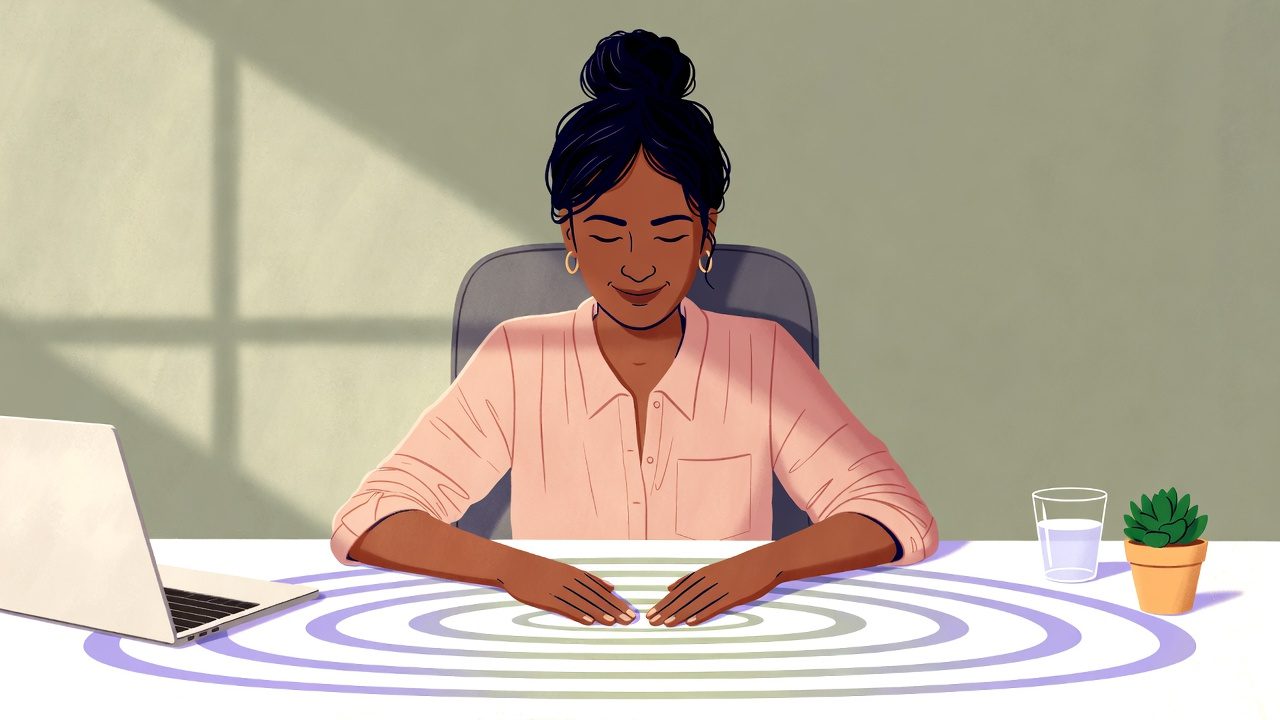
You’re sitting at your desk, trying to hold it together.
An email landed five minutes ago with a subject line that made your stomach clench. Or your manager just sent a message that says “Can we chat?” with no context. Or the deadline you thought was Friday has quietly become today. Or — maybe the hardest one of all — nothing specific has happened. The anxiety just showed up uninvited, like it always does, and now it’s sitting beside you while you’re supposed to be productive.
Your chest is tight. Your thoughts are circling. Your heart rate is a little higher than it should be. And you’re expected to keep going, keep performing, keep looking like you have it together.
Grounding techniques for work anxiety were made for exactly this moment.
They’re not complicated. They don’t require an app, a meditation cushion, or stepping away from your desk. Most can be done completely invisibly — mid-meeting, mid-email, mid-video call — without a single person around you knowing. They won’t solve whatever is causing the anxiety. But they will help you get through the moment — and in the middle of a difficult workday, that is often everything.
This guide covers eight of the most effective techniques, the real-world situations where they matter most, how to build a grounding habit that sets a steadier baseline, and when to recognize that what you’re dealing with needs more than a coping strategy.
Table of Contents
Why Anxiety at Work Is Harder to Manage Than Anxiety Anywhere Else
Most anxiety is uncomfortable. Work anxiety has an extra layer that makes it particularly hard to manage: the performance pressure.
When anxiety hits you at home, you have options. You can take a walk. Lie on the floor. Call someone. Cry if you need to. There’s no audience, no role to maintain, no professional image to protect.
At work, all of those exits are closed. You’re expected to deliver, respond, appear capable, and keep the lid on whatever’s happening beneath the surface. And that expectation doesn’t just sit alongside the anxiety — it feeds it. Because now you’re not just anxious about the trigger. You’re anxious about being visibly anxious. About people noticing. About losing your train of thought in a meeting. About not being able to function the way you’re supposed to.
It becomes a loop. Anxiety about the thing, plus anxiety about the anxiety, plus the pressure to keep performing through both of them. It’s exhausting in a way that’s hard to explain to someone who hasn’t experienced it.
This is exactly why grounding techniques for work anxiety are so valuable specifically in workplace settings. They’re quiet, fast, and private. They work in real time, without requiring you to step out of your professional role or explain yourself to anyone. They meet you in the moment — which is often the only place help is available.
What Grounding Actually Does to Your Brain and Body
Grounding works because it interrupts the anxiety cycle at a physiological level — not just a mental one.
When anxiety spikes, your brain’s threat-detection system activates and floods your body with stress hormones. Your breathing changes. Your heart rate climbs. Blood flows away from your prefrontal cortex — the part of your brain responsible for rational thinking, decision-making, and perspective — and toward your survival systems. According to research from the National Institute of Mental Health, this response is automatic and powerful.
Grounding techniques work by giving your brain something concrete and present to focus on. A physical sensation. A specific sight. A deliberate breath pattern. This interrupts the spiral and signals to your nervous system: you are here, you are in this body, this moment is survivable.
It doesn’t make the stressful situation disappear. But it brings your thinking brain back online — and that changes everything about how you’re able to respond.
The American Psychological Association notes that grounding and mindfulness-based practices are among the most evidence-supported tools for managing acute anxiety. This isn’t folk wisdom. It’s documented, repeatable, and accessible.
Real Situations Where Grounding Techniques Actually Help
Before the techniques themselves, it helps to see them in context. Work anxiety doesn’t just show up in one way — it shows up in dozens of ordinary, recognizable situations.
The Pre-Meeting Panic
Priya manages a team of eight and has presented to executives more times than she can count. She still gets a wave of anxiety in the twenty minutes before every big meeting — a kind of low-grade dread that peaks right as she opens the conference room door.
She used to push through it and hope for the best. Now she runs a two-minute grounding routine at her desk before she leaves for the meeting room. She isn’t completely calm when she walks in — but she is present. And present is enough.
The Inbox That Breaks the Camel’s Back
For Daniel, it’s never one thing. It’s a Tuesday afternoon when four requests land at once, a vague message from his manager appears, and a project he’s been working on for weeks gets quietly shelved. Nothing catastrophic. Just too much, all at once.
He felt his breathing go shallow. His thoughts started cycling: I can’t handle all of this. What did that message mean? I’m going to fall behind. He excused himself to get a glass of water, pressed his palms flat on the kitchen counter, took three slow breaths, and named everything he could see in the room. He came back to his desk five minutes later — still stressed, but no longer spiraling.
The Video Call Nobody Sees You Struggling Through
Leila has worked remotely for two years and still finds video calls deeply anxiety-inducing. She’s never sure what to do with her face, whether she’s talking too much or not enough, whether the tiny delay makes her seem disengaged. By the time most calls end, she’s exhausted from managing all of it.
Now, during calls, she keeps one hand resting flat on her desk throughout. She presses her palm gently into the surface. Nobody sees it. But for her, that consistent physical point of contact keeps her from disappearing into the spiral. It’s her lifeline through forty-five minutes of screen time.
The Free-Floating Dread That Shows Up for No Reason
Some mornings, Marcus arrives at work already tense. No specific trigger. Just a low, humming dread that has no particular object and is looking for something to attach to.
On those mornings, he’s learned to start with grounding before he opens his laptop. Two minutes of deliberate breathing and physical awareness before the first email is read. Not because it fixes anything. But because it sets a steadier baseline to start from — and a steadier baseline means a more manageable day.
The Performance Review That Lives in Your Body for Weeks
When Anya found out she had a performance review coming up, the anxiety didn’t wait for the day of the review. It moved in early. For two weeks before the meeting, she woke up at 3 a.m. running through imaginary conversations, rehearsing defenses for criticisms that hadn’t been made yet.
She started using a simple breathing exercise each time the thoughts began spiraling — both at night and during the day at her desk. It didn’t make the review less daunting. But it kept the anxiety from swallowing the two weeks leading up to it. That’s what grounding does at its best: it doesn’t shrink the thing you’re afraid of. It keeps the fear from filling every space around it.
8 Grounding Techniques for Work Anxiety That Actually Work
Here are eight techniques in total — five you can use invisibly at your desk, and three that require a brief moment away. All of them can be used today, without any preparation.
Invisible Techniques You Can Use Without Anyone Noticing
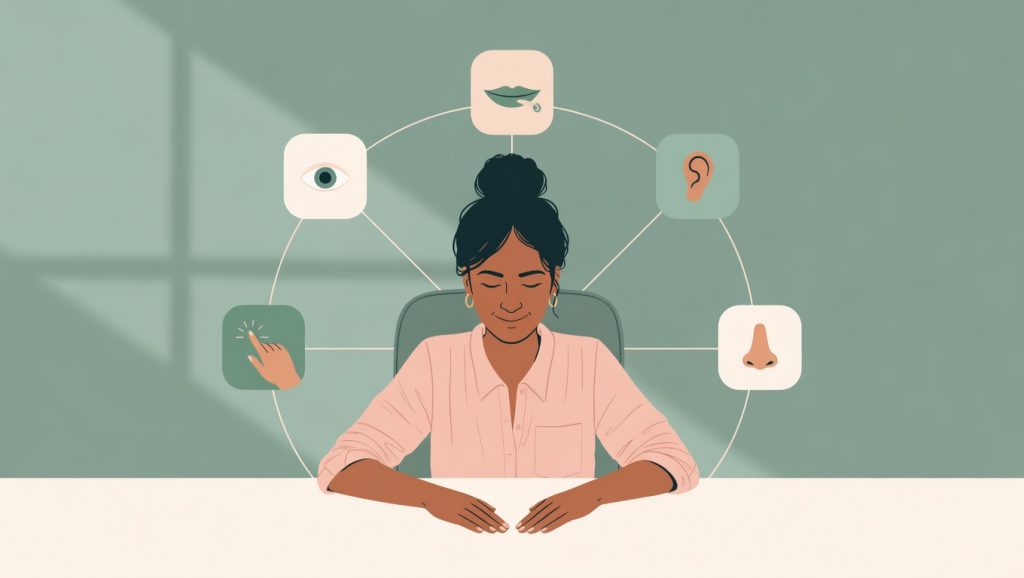
1. The 5-4-3-2-1 Sensory Method
This is one of the most widely used grounding techniques in anxiety management, and for good reason. It works reliably, it takes about ninety seconds, and it can be done entirely in your head.
When anxiety spikes, work through each sense:
- 5 things you can see — your screen, the window, a coffee mug, a plant, someone’s jacket
- 4 things you can physically feel — your feet on the floor, your back against the chair, your hands on the keyboard, the temperature of the air
- 3 things you can hear — typing nearby, the hum of the HVAC, traffic outside
- 2 things you can smell — coffee, fresh air, whatever’s present
- 1 thing you can taste — whatever lingers, even just the inside of your mouth
By the time you finish, your brain has been actively directed away from the anxiety loop and into the sensory reality of your present moment. You’re back in the room.
2. Desk Pressure Grounding
Press both palms flat on your desk. Feel the solid surface beneath them. Push down gently and notice the resistance — the firmness, the texture, the temperature.
This physical sensation sends a concrete signal to your nervous system: something real is here. You are in your body. You are okay.
You can do this while reading an email, while on a call, while staring at a spreadsheet. Nobody sees it. It takes ten seconds. And it reliably pulls you back into the present.
3. Feet on the Floor
This one is so simple that people dismiss it — which is exactly why it’s worth taking seriously.
Press both feet firmly into the floor. Feel the ground beneath you. Notice the pressure of your soles against the surface. If you’re able to take your shoes off, do — that direct contact deepens the effect.
Breathe in slowly, and as you exhale, press your feet down with deliberate intention — like you are actively choosing to stay exactly where you are. Hold that for sixty seconds. It works because it gives your body a concrete answer to the anxiety’s question: where am I? You are here. On this floor. In this room. Right now.
4. Slow the Exhale
When anxiety spikes, your breathing becomes faster and shallower — which actually signals danger to your nervous system and makes the anxiety worse. Breaking that cycle is one of the most powerful things you can do.
Try this: breathe in for a count of four, hold for two, breathe out for six. The extended exhale activates your parasympathetic nervous system — the rest-and-digest state that counteracts the fight-or-flight response. According to research published in the journal Frontiers in Psychology, slow exhalation breathing significantly reduces physiological markers of stress within minutes.
You can do this at your desk, in a meeting with your microphone muted, or on a call while appearing to listen. Nobody around you will know. And because this works at a physiological level, it doesn’t require belief to be effective — your nervous system responds regardless.
5. The Temperature Reset
Keep a cold water bottle at your desk. When anxiety rises, hold it in both hands. Feel the cold, the weight, the solidity. Let the temperature contrast with your warm palms.
If you have access to a sink, run cold water over your wrists for thirty seconds. Cold water activates the dive reflex — a physiological response that slows the heart rate almost immediately. It sounds too simple to be real. But the physiological response is genuine and fast.
Quick Resets When You Have Two Minutes Away
6. The Bathroom Reset
The work bathroom is one of the most underrated tools in managing workplace anxiety. It’s one of the few spaces you can occupy alone, briefly, without explanation or justification.
When you’re spiraling, excuse yourself. Once there: run cold water over your wrists, look at your own face in the mirror and take three slow breaths, run through the 5-4-3-2-1 exercise quietly. Come back to your desk two minutes later as a slightly more grounded version of yourself.
7. The Mindful Errand Walk
Give yourself a legitimate reason to move — refill your water, drop something at a colleague’s desk, check the printer. As you walk, pay deliberate attention to the physical experience of walking. Feel each footfall. Notice your arms moving. Look at what’s around you without judgment or commentary.
You’re not escaping. You’re resetting. The movement itself helps metabolize stress hormones, and the shift in environment breaks the anxiety loop in a way that staying at your desk can’t.
8. Box Breathing
Used by surgeons, pilots, and military personnel in high-stress situations, box breathing is straightforward and reliably effective.
Breathe in for four counts. Hold for four. Breathe out for four. Hold for four. Repeat four times.
That’s one minute. One structured, deliberate minute that can genuinely shift the trajectory of a difficult hour.
How to Build a Daily Grounding Habit at Work
The techniques above are most effective when they’re already practiced — when your nervous system knows them and can access them quickly when anxiety spikes.
Here’s how to build grounding into your workday without adding another complicated thing to your routine.
Start With a Morning Baseline Ritual
Before you open your laptop, read the first email, or check your calendar: two minutes of deliberate grounding. Feet on the floor. Hands around a warm drink. Three slow, deliberate breaths.
This isn’t meditation. It doesn’t need to be spiritual or complicated. It’s simply setting a baseline before the workday sets it for you. Those two minutes can change the entire quality of the morning.
Identify Your Specific Triggers
Take a moment to think about what actually tends to trigger your work anxiety. Is it certain people? Certain types of feedback? Unpredictability? High email volume? Early morning? Performance-related pressure?
When you know your personal triggers, you can prepare — and sometimes restructure your environment to reduce unnecessary exposure. You can have a technique ready before the trigger happens, rather than scrambling to find one after.
Create a Work-to-Home Transition Ritual
One of the biggest contributors to ongoing work anxiety — particularly for remote workers — is the absence of a clear boundary between work and not-work. The commute used to provide this naturally. Without it, anxiety bleeds through.
Create a deliberate transition. A walk around the block. A changed outfit. A specific piece of music. Five minutes outside. Something that signals to your nervous system: the work part of the day is over. This matters more than most people realize, and it directly affects both evening anxiety and sleep quality. If you’re finding rest increasingly difficult to come by, it’s worth exploring what we cover in Why Rest Doesn’t Always Feel Restful — because the connection between unresolved work anxiety and non-restorative rest runs deep.
Actually Take Your Lunch Break
Not at your desk. Not while answering emails. A real break — fifteen to twenty minutes away from your screen — where your nervous system gets a genuine pause.
This is not laziness. It’s a physiological requirement for afternoon function. People who take real lunch breaks consistently report lower afternoon anxiety, better focus, and more energy through the end of the day.
Practical Steps to Start Using These Techniques This Week
You don’t need to implement all eight at once. Here’s a simple starter plan.
Today: Try desk pressure grounding the next time you feel your anxiety start to climb. Press your palms flat on your desk and hold for thirty seconds. Notice what shifts.
This week: The next time anxiety spikes in a meeting or on a call, slow your exhale. Breathe in for four counts, hold for two, breathe out for six. Do it twice. Notice whether your thinking feels clearer afterward.
Starting tomorrow morning: Before opening your laptop, spend ninety seconds with your feet on the floor and your hands around a warm drink. Don’t reach for your phone. Just breathe and notice. That’s a morning grounding ritual — and it takes less time than scrolling.
When you have a difficult day: Use the 5-4-3-2-1 method. Run through it in your head during any meeting, at your desk, or in the bathroom reset. Name five things you can see right now.
None of these require any equipment, any privacy, or anyone else’s knowledge or cooperation. They just require you to try.
When Grounding Techniques for Work Anxiety Are Not Enough
There’s a version of using grounding techniques that starts to feel like holding a finger over a crack in the wall. Useful, necessary even — but not the same as fixing the wall. If you find yourself needing these tools constantly just to get through ordinary days, that’s information. It means something beneath the surface needs more than management.
If work anxiety is persistent and pervasive — if it’s affecting your sleep, your relationships outside work, your sense of identity, your physical health, or your ability to do the most basic functions of your role — it deserves more than better coping strategies.
That might mean examining what is actually generating the anxiety. Is it the workload? The culture? A specific relationship? A mismatch between your role and your values? Sometimes anxiety is a signal, not just a symptom — and no amount of breathing resolves a structural problem that needs to change. Understanding the difference between stress and burnout is a helpful starting point for figuring out what you’re actually dealing with.
It might also mean looking more closely at what the signs of your work stress are actually telling you. If you’ve been wondering whether your experience goes beyond ordinary pressure, the detailed breakdown in identifying signs of work stress can help you understand where you are.
And it might mean seeking professional support. Therapy — particularly Cognitive Behavioral Therapy (CBT) or Acceptance and Commitment Therapy (ACT) — is highly effective for anxiety disorders and chronic workplace anxiety. A therapist doesn’t just help you manage symptoms. They help you understand and shift the patterns underneath them. If you’ve been wondering whether it’s time, how to know when to see a therapist offers honest, non-pressuring guidance for that decision.
According to the Mayo Clinic, anxiety disorders are among the most common and treatable mental health conditions — and getting support is a sign of self-awareness, not weakness.
You Can Be Anxious and Still Get Through This
Here’s what sometimes gets lost in the conversation about tools and techniques: the goal is not to eliminate anxiety from your working life. The goal is to build a relationship with it that doesn’t knock you off your feet.
Anxiety will still visit. Difficult emails will still land. Meetings will still feel daunting. Work will still be demanding in ways that sometimes feel like too much.
But you don’t have to be helpless inside those moments. You can have tools — small, quiet, portable grounding techniques for work anxiety that bring you back to yourself when you’ve drifted somewhere frightening. Tools that carry a reminder with them: you are here, in this body, in this moment — and this moment is survivable.
One breath at a time. One grounded minute at a time. One difficult day navigated, and then another.
You’re more capable of getting through this than your anxiety wants you to believe. Every time you use one of these techniques, you’re proving it.
Frequently Asked Questions About Grounding Techniques for Work Anxiety
1. What are grounding techniques and do they actually work for work anxiety?
Grounding techniques are evidence-supported practices that bring your attention out of anxious thought spirals and back into your physical body and immediate surroundings. They work by interrupting the fight-or-flight response and giving your brain something concrete to focus on — signaling to your nervous system that you are safe in the present moment. They are genuinely effective for getting through difficult moments with more steadiness, though they are management tools rather than long-term cures.
2. Can I use grounding techniques during a meeting without anyone noticing?
Yes — several techniques in this article are specifically designed to be invisible. Pressing your palms flat on your desk, keeping one hand resting on a surface, pressing your feet firmly into the floor, and slowing your exhale are all invisible during meetings or video calls. The 5-4-3-2-1 method can also be run through silently in your head while appearing to listen.
3. How quickly do grounding techniques work?
Most techniques have a noticeable effect within sixty to ninety seconds. Controlled breathing with an extended exhale can begin shifting your physiological state within thirty seconds, because it directly activates the parasympathetic nervous system. You may not feel completely calm afterward, but you will feel more present and less caught in the spiral.
4. What is the best grounding technique for work anxiety?
There is no single best technique — it depends on what resonates with you personally. That said, if you’re new to grounding, start with the slow exhale: breathe in for four counts, hold for two, breathe out for six. It requires nothing, works anywhere, and has an immediate physiological effect whether or not you believe it will. Once that feels natural, add the 5-4-3-2-1 method for breaking a spiral, and desk pressure grounding for invisible use in meetings.
5. What is the 5-4-3-2-1 grounding technique?
The 5-4-3-2-1 technique is a sensory awareness exercise that anchors you in the present moment. You identify 5 things you can see, 4 things you can physically feel, 3 things you can hear, 2 things you can smell, and 1 thing you can taste. By directing your attention through each sense in sequence, your brain is pulled out of the anxiety loop and into the reality of your immediate surroundings. It takes about ninety seconds and can be done entirely in your head.
6. Why does work anxiety feel worse than anxiety in other areas of life?
Work anxiety carries an extra layer of performance pressure — the expectation that you’ll continue functioning, appearing competent, and delivering results even while your nervous system is activated. This leads to anxiety about being visibly anxious, which amplifies the original anxiety into a loop. Grounding techniques are particularly valuable in work contexts because they’re invisible and fast.
7. Can grounding techniques help with anxiety before a presentation or big meeting?
Yes, significantly. Running through a two-minute grounding routine before a high-stakes meeting — slow breathing, feet on the floor, a quick 5-4-3-2-1 scan — helps bring your thinking brain back online before you walk in. You may not feel calm, but you will feel more present, which is what actually matters for performance.
8. Are grounding techniques safe to use alongside therapy or medication?
Yes. Grounding techniques are gentle, self-directed tools that complement any other form of support, including therapy and psychiatric medication. They are not a substitute for professional care, but they are entirely compatible with it and can be practiced alongside any treatment plan.
9. How do I know if my work anxiety is serious enough to need professional help?
If your anxiety is persistent, pervasive, affecting your sleep, physical health, relationships, or ability to function in your role — it deserves professional attention. Grounding techniques are most helpful for acute moments; they are not designed to address the underlying patterns that generate chronic anxiety. A therapist, particularly one trained in CBT or ACT, can help with that work. If you’re unsure, it’s always better to reach out and find out than to wait.
10. What should I do when grounding techniques stop working during a really difficult period?
If you’re in an extended period of high stress where grounding tools are no longer sufficient, that’s important information. It’s a sign that the load is exceeding your current coping capacity — and that’s not a personal failing. It may mean the situation itself needs to change, you need more structured support, or both. Consider whether what you’re experiencing matches signs of burnout, and reach out to a mental health professional who can give you a more individualized assessment.
Disclaimer
This article is written for informational and supportive purposes only. It is not a substitute for professional mental health advice, diagnosis, or treatment. The author of Mindbloom is not a licensed therapist, psychologist, or medical professional. If you are experiencing significant anxiety, persistent mental health symptoms, or any form of crisis, please reach out to a qualified mental health provider or contact a crisis line in your area. Always consult a licensed professional before making changes to any mental health treatment plan.