
Midlife Mental Health Crisis: What It Really Means — and How to Heal

A midlife mental health crisis rarely announces itself with drama. More often, it arrives as a quiet, unsettling question — sitting at a dinner table or in a work meeting you’ve attended a hundred times — Is this really my life? And if it is, why does it feel like it belongs to someone else?
If that moment sounds familiar, you are not alone. A midlife mental health crisis is one of the most universal, least-talked-about experiences of adult life. And the fact that you are asking the question at all is not a breakdown. It is a beginning.
This article is for anyone who is somewhere in the middle of their story and wondering who they actually are now that the earlier chapters have settled. Whether you are 38 or 55, whether your life looks “successful” from the outside or quietly unraveling, this is your space.
Table of Contents
What Is a Midlife Mental Health Crisis, Really?
Most of us grew up with a certain image of the midlife crisis — the red sports car, the dramatic haircut, the sudden life upheaval. Pop culture turned something genuinely profound into a punchline. But the real experience is far quieter, far more internal, and far more meaningful than any cliché.
A midlife identity crisis is not a breakdown. It is a recalibration.
It happens when the identity you built in your 20s and 30s — often built around roles, expectations, other people’s needs, and your best guesses about who you should be — stops fitting the person you have actually become. The scaffolding that held your sense of self together starts to feel rickety. And instead of ignoring it, your mind and your heart start pulling it apart.
The American Psychological Association describes identity development as an ongoing process that does not stop at young adulthood. It continues, deepens, and sometimes radically shifts throughout life — especially in midlife, when major life transitions collide with a growing sense of one’s own mortality and legacy.
This is not weakness. This is growth trying to happen.
Why Midlife Mental Health Often Comes to a Head in Your 40s and 50s
There are specific reasons why midlife tends to be the season when identity and mental health collide so powerfully.
Life transitions stack up. In midlife, you are often navigating multiple massive changes at the same time. Children leaving home. Aging parents needing care. Career ceilings or reinventions. Shifts in relationships. The body changing in ways that cannot be ignored. Each transition on its own would be significant. Together, they can feel seismic.
The gap between expectation and reality becomes undeniable. By midlife, you have had enough time to see how life actually turned out versus how you imagined it would. That gap can carry grief, disappointment, resentment, and confusion — or it can carry surprising relief and permission to want something different.
The question of time changes. Researchers at the University of California, San Diego have studied how the perception of time shifts in midlife. Rather than thinking about how much time has passed, people start thinking about how much time remains. That shift fundamentally changes what feels important, urgent, and worth protecting.
Social roles start to feel hollow. You have been the responsible one, the provider, the caretaker, the high-achiever, or the peacekeeper for so long that you may have lost track of who exists underneath those roles. When the roles start to feel like costumes rather than a core identity, the disorientation can be profound.
Real Stories: What a Midlife Mental Health Shift Actually Looks Like
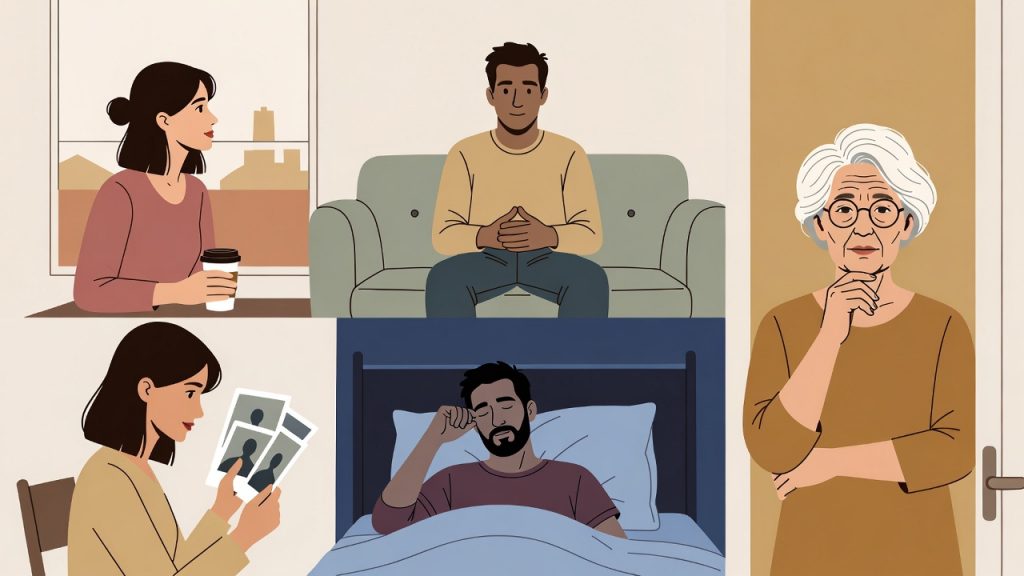
Sometimes the most helpful thing is to see yourself in someone else’s story. Here are five scenarios that reflect what midlife mental health and identity struggles really look like in everyday life.
Karen, 47. After 20 years in a career she chose because it was practical, Karen sat in a promotion meeting and felt nothing — not pride, not excitement, not even relief. Just a hollow sense that the ladder she had been climbing led somewhere she didn’t actually want to go. She started questioning everything she thought she knew about herself.
David, 52. His kids left for college within two years of each other. David had defined himself as a dad for so long that when the house went quiet, he didn’t know what to do with himself. He described it as “suddenly being a stranger in my own life.” He had never asked himself what he actually wanted when no one needed anything from him.
Priya, 44. After her divorce, Priya realized she had spent her entire adult life being who her family, her culture, and her ex-husband expected her to be. “I got to 44 and realized I had never actually chosen my own life,” she said. “I had just agreed to everyone else’s version of it.”
Marcus, 49. Marcus had what looked like a great life from the outside. Good job, loving family, comfortable home. But he started waking up at 3 a.m. with a racing heart, a sense of dread he couldn’t name, and an overwhelming feeling that he was running out of time to become who he was supposed to be.
Elena, 55. After her mother passed away, Elena found herself rethinking everything — her friendships, her spiritual beliefs, her daily habits, her sense of purpose. Grief had stripped away the noise, and what remained was a woman asking, quietly and seriously, what she actually believed about her own life.
None of these people were failing. All of them were at the edge of something important.
The Connection Between Midlife Identity and Mental Health
The link between identity confusion and mental health is not incidental. It is direct.
When we lose our sense of who we are — or when the identity we have been maintaining starts to feel false — it creates a specific kind of psychological pain. Researchers call it “identity disruption,” and it is closely tied to elevated levels of anxiety, depression, and emotional dysregulation.
The National Institute of Mental Health notes that depression in midlife often presents differently than in younger adults. It may look more like numbness, irritability, loss of meaning, or physical symptoms than classic sadness. This is partly why midlife depression is so often missed — both by the person experiencing it and by the people around them.
There is also a strong body of research, including studies published by the Mayo Clinic, suggesting that hormonal shifts in midlife — particularly menopause in women and declining testosterone in men — can significantly affect mood, sleep, anxiety, and a person’s overall sense of themselves. These biological shifts interact with psychological ones in complex ways.
The body and the mind are always talking to each other. In midlife, that conversation gets loud. Exploring the connection between your physical and emotional world can be a powerful part of the healing — something the Body & Mind space here at Mindbloom explores in depth.
Signs That Midlife Mental Health May Need Your Attention
Not every feeling of restlessness or questioning is a crisis. But there are signs worth taking seriously.
You may want to pay attention if you notice:
- A persistent sense of emptiness or meaninglessness that does not lift, even when things are going well
- Increasing irritability, anger, or emotional volatility that feels out of proportion to what is actually happening
- Withdrawal from people and activities that used to feel fulfilling
- Sleep disturbances — either sleeping too much or lying awake for hours
- A growing sense that you are “performing” your life rather than actually living it
- Recurring thoughts about mortality, regret, or missed opportunities that feel intrusive rather than reflective
None of these are signs that you are broken. They are signals. And signals are worth listening to.
Midlife Mental Health and the Courage to Reinvent Your Identity
Here is something that does not get said enough: reinventing yourself in midlife is not a sign of failure. It is one of the most courageous things a person can do.
Identity is not a fixed destination. It is something you build, rebuild, and refine across an entire lifetime. Research from Harvard Health suggests that people who engage in what psychologists call “identity exploration” in midlife — actively questioning and reforming their sense of self — report higher levels of life satisfaction and psychological wellbeing in later life compared to those who rigidly maintain an identity that no longer fits.
You are allowed to change. You are allowed to want different things than you wanted at 25. You are allowed to outgrow the version of yourself that got you this far.
If you have ever felt the quiet pull of wanting to understand what truly matters to you, exploring your core values is one of the most grounding places to start. Knowing what you genuinely believe in — not what you were told to believe in — becomes an anchor when everything else feels uncertain.
Practical Steps to Support Your Midlife Mental Health and Identity
This is not about fixing yourself. It is about beginning to listen to yourself, maybe for the first time in years.
1. Name the feeling — without judging it. The first step in any identity recalibration is simply allowing yourself to feel what is actually there. Not the feelings that are “appropriate” or “reasonable” — the real ones. Journaling, quiet reflection, or even talking out loud to yourself can help bring these feelings into focus. A structured emotional check-in practice can be a surprisingly powerful tool for this.
2. Separate who you are from the roles you play. Make a list of the roles you currently hold: parent, spouse, employee, caretaker, provider, fixer. Then ask yourself: if all of those roles disappeared tomorrow, who would be left? This is not a trick question. It is an invitation to meet yourself beneath the responsibilities.
3. Revisit what you loved before life got so full. Think back to what you loved before life got so full. What did you care about before you decided it wasn’t practical? Before someone told you it wasn’t worth pursuing? The things that lit you up at 15 or 22 often hold clues about the parts of you that have been waiting quietly.
4. Grieve what needs to be grieved. Part of midlife identity work is grief. You may be mourning a version of the future that isn’t going to happen. A relationship that did not survive. A career path not taken. A version of yourself that you buried to meet other people’s needs. Grief is not weakness. It is the honest acknowledgment of something that mattered.
5. Find one relationship where you can be completely honest. Isolation makes identity confusion much worse. Find at least one person — a friend, a therapist, a group — who allows you to show up honestly. Attachment patterns formed early in life can make authentic connection feel risky, but understanding those patterns (explored in depth in this piece on attachment style in relationships) can help you open up in ways that feel safe.
6. Consider professional support. There is no shame in recognizing that this kind of inner work is big enough to need guidance. A therapist who specializes in life transitions can be genuinely transformative. If you are unsure where to start, the different types of therapy article on Mindbloom breaks down your options in plain, accessible language.
7. Introduce small, intentional experiments. You do not have to overhaul your entire life to begin finding yourself again. Start small. Sign up for one class. Spend one Saturday morning doing something entirely for yourself. Try one honest conversation. Identity is rebuilt through small, repeated acts of choosing yourself.
8. Follow the moments when you feel most like yourself. Not happy in a surface way — but alive. Present. Like yourself. Notice the moments, however brief, when you feel most at home in your own skin. They are breadcrumbs. Follow them.

What Midlife Mental Health Recovery Actually Looks Like
Recovery from a midlife identity crisis is not a dramatic transformation. Most people do not wake up one day with a completely new life. What actually happens is more like a slow turning of a ship.
You start to make choices that are more aligned with who you actually are. You start to say no to things that were never really yours to carry. You let some relationships go deeper and release others that were held together only by habit. You begin to feel, gradually and imperfectly, more like yourself.
The American Psychological Association notes that psychological flexibility — the ability to adapt to changing circumstances while staying connected to your core values — is one of the strongest predictors of mental health in midlife and beyond. This is not about having everything figured out. It is about being willing to keep going even when you do not.
Many people who come through a midlife mental health shift describe it as the most important thing that ever happened to them. Not because it was easy, but because it finally asked them to be real.
You Are Not Too Late
One of the most painful parts of a midlife mental health crisis is the quiet, persistent fear that you have left it too late. That too much time has passed. That the window has closed.
It has not.
Research consistently shows that humans are remarkably capable of change, growth, and reinvention at every stage of life. The brain retains neuroplasticity — the ability to form new patterns and ways of thinking — well into older adulthood. Your story is not written. It is still being written.
And sometimes the most important chapters are the ones that come after the middle, after the questioning, after the honest reckoning with who you really are and what your one life is actually for.
The restlessness you feel? It is not the end of something. It is the beginning.
Frequently Asked Questions About Midlife Mental Health and Identity
1. What is a midlife mental health crisis and how do I know if I’m having one? A midlife mental health crisis typically involves a period of intense questioning of your identity, purpose, and choices, often accompanied by anxiety, depression, or emotional restlessness. You might feel that your life no longer fits, that your roles feel hollow, or that you are “going through the motions.” It is different from a bad week — it is a sustained inner shift that persists even when external circumstances are stable.
2. What age does a midlife mental health crisis typically start? While the popular image suggests it happens at exactly 40, research shows midlife identity and mental health challenges can begin as early as the late 30s and extend well into the mid-50s. There is no single triggering age — it is more about life stage and accumulated transitions than a specific number.
3. Is a midlife crisis the same as depression? Not exactly, but they often overlap. Midlife identity questioning can trigger or worsen depression, and untreated depression can make the questioning much harder to move through constructively. If you are experiencing persistent low mood, hopelessness, sleep disruption, or loss of interest for more than two weeks, it is worth speaking with a mental health professional.
4. Can men experience a midlife mental health crisis, or is it mostly women? Both men and women experience midlife mental health and identity challenges, though they often express differently. Men may be less likely to verbalize the emotional aspects and more likely to show it through behavioral changes, irritability, risk-taking, or withdrawal. Hormonal shifts, particularly declining testosterone, can also affect mood, energy, and identity for men in significant ways.
5. How do I cope with a midlife mental health crisis and start healing? Start with honest reflection rather than immediate action. Journaling, therapy, or even a trusted conversation with someone who knows you well can help. Reconnecting with values, revisiting old interests, and creating small spaces of genuine choice in your daily life are all meaningful starting points.
6. Is it normal to feel like you don’t know yourself in your 40s? Yes, deeply and widely normal. Many people describe midlife as the first time they have seriously asked themselves who they actually are beyond the roles and expectations they carry. The feeling of not knowing yourself is not a failure — it is the beginning of finding out.
7. Can a midlife crisis lead to positive change? Absolutely. Research consistently shows that people who engage thoughtfully with midlife identity questioning — rather than suppressing it or making impulsive choices to escape it — often report greater life satisfaction, stronger relationships, and a more authentic sense of self in the years that follow.
8. What role does therapy play in midlife mental health? Therapy can be enormously valuable during midlife transitions. A good therapist helps you process grief, clarify values, work through relationship patterns, and navigate the uncertainty of identity reinvention with a grounded, supportive presence. Life transition therapy and existential therapy approaches are particularly well-suited to midlife work.
9. How do I support a partner or loved one going through a midlife identity crisis? Listen without trying to fix. Avoid minimizing their experience with phrases like “you have so much to be grateful for.” Ask open questions. Create space for honest conversation. Encourage professional support if the distress is significant. And take care of your own mental health too — being close to someone in a major life transition is its own emotional challenge.
10. How is a midlife identity shift different from the mental health challenges of young adulthood? Young adulthood tends to involve building an identity from the ground up, figuring out who you are for the first time. Midlife involves a different kind of reckoning — examining the identity you already built, questioning whether it truly fits, and having the courage to revise it. Both are hard. But midlife identity work carries its own particular texture of grief, depth, and possibility that is distinct from earlier developmental stages.
A Closing Word
If you made it here, something in this brought you. Maybe it was curiosity. Maybe it was recognition. Maybe it was the quiet relief of seeing your own experience described without judgment.
Whatever brought you — you are exactly where you need to be.
Midlife mental health challenges do not mean you have done something wrong. They mean you are paying attention. They mean some part of you cares enough about your own life to ask hard questions about it. And that is not a problem to solve. That is a person choosing, even imperfectly, to live honestly.
You are not behind. You are not broken. You are blooming — in the hard, slow, beautiful way that only happens when you stop pretending and start becoming.
Keep going. The best chapters are still being written. If you are ready for a gentle next step, the emotional check-in practice is a quiet, honest place to start.
Disclaimer
This article is written for informational and personal support purposes only. It is not a substitute for professional mental health advice, diagnosis, or treatment. Mindbloom is a personal wellness blog, not a clinical resource. If you are experiencing a mental health crisis, persistent depression, anxiety, or thoughts of self-harm, please reach out to a qualified mental health professional or contact a crisis helpline. In the United States, you can call or text 988 to reach the Suicide and Crisis Lifeline at any time.