
How Your Circadian Rhythm Controls Your Mood — And What to Do When It’s Off
Have you ever noticed how everything feels just a little harder on the days after a bad night’s sleep? The irritability that comes out of nowhere. The sadness that sits on your chest before you even get out of bed. The anxiety that spikes before you’ve had your first cup of coffee. If this sounds familiar, there is a very real, very biological reason for it — and it has everything to do with your circadian rhythm and mood regulation.
Your body has an internal clock running quietly in the background every single day. It controls far more than just when you feel sleepy. It shapes your emotions, your energy, your stress response, and even how hopeful or hopeless you feel about your life. When that clock is ticking in rhythm, you feel more like yourself. When it falls out of sync, everything from your patience to your perspective can begin to unravel.
This article is going to walk you through exactly what is happening inside your body, why it matters so deeply for your mental health, and — most importantly — what you can gently do about it.
Table of Contents
What Is Your Circadian Rhythm — And Why Does It Go Beyond Sleep?
Most people have heard the term, but it often gets reduced to “your sleep schedule.” That is only part of the story.
Your circadian rhythm is a roughly 24-hour biological cycle that governs almost every system in your body. It tells your cells when to repair themselves, tells your digestive system when to expect food, tells your immune system when to ramp up activity, and tells your brain when to release which chemicals and in what amounts.
It is not one single process. It is a symphony of thousands of tiny biological clocks, all conducted by a small region in your brain called the suprachiasmatic nucleus (SCN) — which sounds complicated, but all you really need to know is this: it lives just above where your optic nerves cross, and it takes its most important cues from light.
Light is the most powerful signal your internal clock receives. When light enters your eyes in the morning, it tells your brain: it is time to be awake, alert, and alive. When darkness falls, it signals: time to wind down, repair, and restore. Every hormone, every neurotransmitter, every chemical tied to how you feel emotionally follows this rhythm.
So when that rhythm is disrupted — by late nights, early alarms, shift work, travel, too much screen time, or chronic stress — it is not just your sleep that suffers. Your emotional world gets shaken up too.
How Your Circadian Rhythm Directly Shapes Serotonin, Cortisol, and Melatonin
Here is where things get really personal.
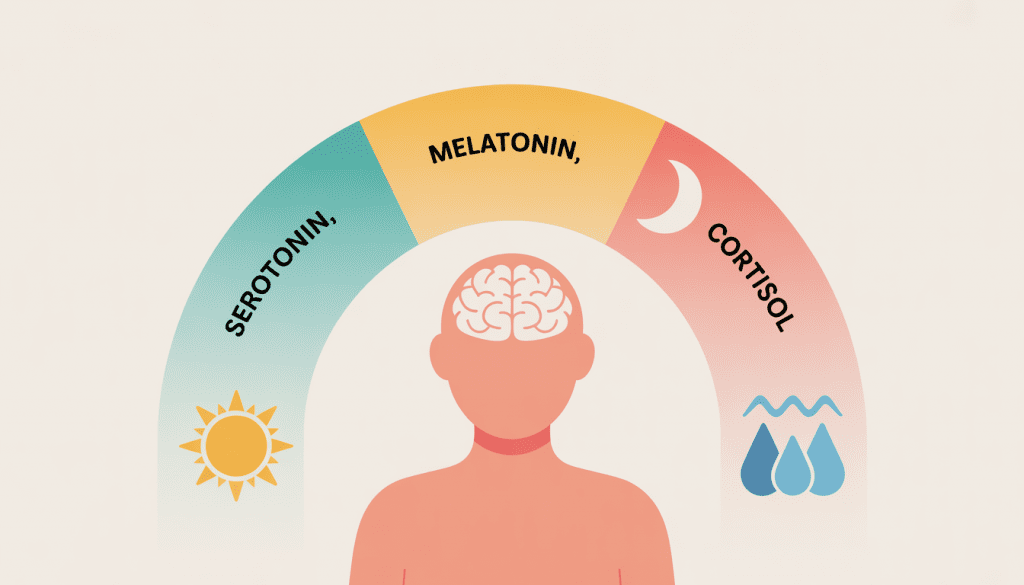
Your circadian rhythm directly controls the release of serotonin — the neurotransmitter most associated with feelings of calm, contentment, and emotional stability. Serotonin peaks during daylight hours, especially in the morning, and naturally drops as the day winds down. This is part of why mornings, when your rhythm is working properly, can feel like a fresh start.
It also controls melatonin, which is not just a sleep hormone. Melatonin plays a role in emotional buffering and helping your nervous system feel safe enough to rest. When your rhythm is off, melatonin does not rise at the right time, leaving your nervous system on edge even when you are physically exhausted.
And then there is cortisol — your stress hormone. In a healthy rhythm, cortisol naturally peaks about 30 to 45 minutes after waking. This is actually a good thing. That morning cortisol spike is what gives you the motivation to get up, engage with your day, and handle what comes your way. But when your circadian rhythm is disrupted, cortisol can spike at the wrong times — or stay elevated throughout the day — leaving you feeling anxious, reactive, and emotionally thin-skinned.
The link between circadian rhythm and mood regulation is not a soft, indirect one. It is direct, measurable, and biological. Research from institutions like the National Institute of Mental Health has consistently found that circadian disruption is closely linked to anxiety, depression, bipolar disorder, and seasonal mood changes.
Real Life: What Circadian Disruption Actually Feels Like
Before we go any further, let’s bring this into your actual life. Because what we’re describing is not a distant medical concept — it is playing out right now, in real households, in quiet Monday mornings, in the exhaustion that does not make sense.
Scenario 1: The Sunday Night Spiral
You stayed up later than usual on Friday and Saturday night, sleeping in to compensate. Sunday evening, you cannot fall asleep at your normal time. You lie there, wide awake at midnight, scrolling your phone. Monday morning arrives like a wall. You are exhausted, irritable, and inexplicably anxious. Your mood is shot before the day even begins. This is sometimes called “social jet lag” — and it is circadian disruption in action.
Scenario 2: The Winter Blues That Feel Like More
Every November, you notice a shift. You feel heavier, slower, more withdrawn. You want to sleep more, eat more, and see people less. You tell yourself it is just the weather. But it is not just the weather — it is the shortening days reducing your light exposure, which disrupts your serotonin production and throws your internal clock into a kind of seasonal confusion. This is why Seasonal Affective Disorder (SAD) is a real clinical diagnosis — and why light therapy works so well for it.
Scenario 3: The Night Shift Worker
A nurse working rotating night shifts notices that she cries more easily, snaps at her partner, and feels a constant low-grade sadness she cannot explain. She attributes it to stress. But her body clock has been forced to run completely opposite to the natural light-dark cycle. Her serotonin and melatonin are releasing at the wrong times, her cortisol is dysregulated, and her emotional nervous system is exhausted.
Scenario 4: The College Student Who Never Sleeps
A university student has been pulling late nights studying, sleeping from 3 a.m. to noon. He notices that his anxiety is getting worse, his motivation is disappearing, and even things he used to enjoy feel flat. His circadian rhythm has shifted dramatically, and with it, so has his neurochemical balance.
Scenario 5: The Stressed Parent
A new parent wakes up multiple times a night for months. Beyond the obvious exhaustion, they notice mood swings they have never experienced before, a lowered emotional threshold, and a sense of gloom that feels uncharacteristic. Fragmented sleep is one of the most potent disruptors of circadian rhythm — and therefore, of emotional regulation.
Do any of these feel familiar? You are not imagining it. Your body is talking to you.
Why This Matters for Anxiety and Depression Specifically
The relationship between circadian disruption and mental health conditions is one of the most important and under-discussed conversations in wellness today.
Research published in journals like The Lancet Psychiatry has found that people with disrupted circadian rhythms are significantly more likely to experience depression, anxiety, and mood instability. This is not correlation — there is a clear biological mechanism at work.
When your serotonin production is chronically low due to poor light exposure and disrupted sleep, your brain has fewer resources to regulate emotion. When your cortisol curve is flattened or jagged, your stress response becomes hair-trigger sensitive. When your melatonin is suppressed by late-night screens, your nervous system never fully moves into the restorative rest it needs to process the emotional weight of the day.
This is also why many people who struggle with depression report that their symptoms are worst in the morning — because cortisol, which should be motivating and energizing, feels overwhelming instead. It is the rhythm that is off, not just the chemical.
Understanding this does not mean your feelings are just biology. Your feelings are real and valid. But knowing that there is a physical rhythm underneath your emotional experience can be deeply empowering. It means there are tangible things you can do to gently support your own mood from the inside out. And if you have been exploring whether your sleep might be at the root of your emotional struggles, you might find our piece on sleep deprivation and depression particularly eye-opening.
How Screen Time Is Quietly Disrupting Your Mood
This one deserves its own section, because it affects almost all of us.
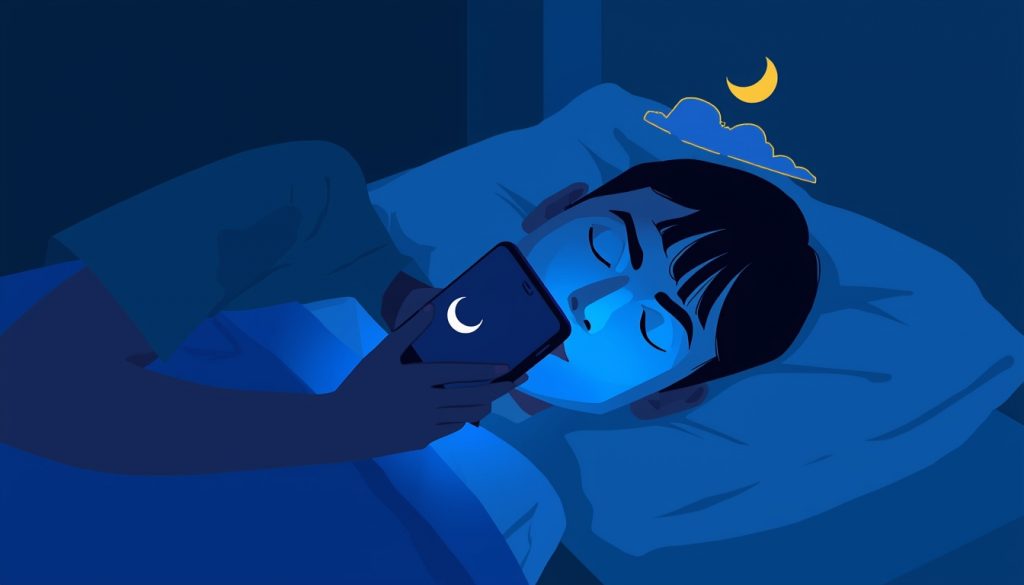
Screens emit blue light — a wavelength of light that is almost identical, in terms of biological signal, to daylight. When you look at your phone at 10 p.m., your suprachiasmatic nucleus receives a message that says: it is still daytime. Stay alert. Suppress melatonin.
And it does exactly that.
The result is not just delayed sleep. It is delayed emotional recovery. Your brain needs the hormonal shift that comes with nighttime to process the emotional events of the day, consolidate memories, and restore the neurochemical balance you need to wake up stable and resilient.
The Harvard Medical School’s Division of Sleep Medicine has published extensive research on how blue light at night disrupts melatonin production and affects mood and cognitive function. The practical implication is simple, even if not always easy: your screens are not emotionally neutral tools. They have a direct pipeline to your body clock and, through it, to how you feel.
The Role of Meal Timing in Your Emotional Rhythm
Here is something that surprises many people: what time you eat matters almost as much as what you eat when it comes to your circadian rhythm.
Your digestive system, liver, and metabolic organs all have their own circadian clocks, and they sync with the master clock in your brain partly through the timing of meals. Eating late at night, skipping breakfast regularly, or having your largest meal close to bedtime can all send confusing signals to your internal clock — contributing to mood instability, energy crashes, and even increased anxiety.
Studies from the American Psychological Association have explored how meal timing affects cortisol levels and emotional resilience. The short version: eating earlier in the day and keeping meal times consistent supports a more stable cortisol curve, which means a more stable emotional baseline.
This does not mean you need to be rigid or obsessive about meal times. But it does mean that the simple act of having breakfast — real, nourishing breakfast — within an hour or two of waking can gently anchor your circadian rhythm and give your mood a steadier foundation.
Practical Steps to Support Your Circadian Rhythm (and Your Mood)

Now let us get into what you can actually do. These are not extreme lifestyle overhauls. They are gentle, consistent habits that work with your body’s natural design.
1. Get Morning Light — Especially in the First Hour of Your Day
This is the single most powerful circadian reset available to you, and it is completely free.
Step outside within 30 to 60 minutes of waking up. Even on a cloudy day, natural outdoor light is significantly brighter than indoor lighting, and it delivers the biological signal your suprachiasmatic nucleus needs to anchor your internal clock. This morning light exposure triggers the serotonin surge that supports a stable, positive mood throughout the day — and it sets the timer for melatonin to rise approximately 14 to 16 hours later, at the right time for sleep.
If you have been struggling with low mood, anxiety, or emotional flatness, this single habit — practiced consistently for two to four weeks — can produce a noticeable difference.
2. Create a Consistent Sleep and Wake Schedule
Your circadian rhythm thrives on consistency. Going to bed and waking up at roughly the same time every day — yes, including weekends — is one of the most supportive things you can do for your emotional stability.
You do not need to be in bed by 9 p.m. You need to be consistent. A consistent rhythm keeps your hormone release on schedule, which keeps your mood more predictable and manageable. For more ideas on building a routine that actually sticks, our article on sleep hygiene habits that actually work walks you through the practical details.
3. Reduce Blue Light in the Evening
Start dimming your exposure to bright, blue-spectrum light about 60 to 90 minutes before bed. This can look like:
- Switching your phone and laptop to “night mode” or warm color settings
- Using warm-toned lamps instead of overhead lights in the evening
- Wearing blue-light filtering glasses if you need to use screens late
- Replacing the last scroll session with something screen-free: a book, a bath, light stretching, or simply sitting quietly
The goal is to give your brain permission to begin its hormonal wind-down on time.
4. Move Your Body — Especially in the Morning or Early Afternoon
Exercise is a powerful circadian synchronizer. Physical movement, particularly when it happens earlier in the day, helps anchor your body clock, boosts serotonin, reduces cortisol, and improves the quality and timing of your sleep.
This does not need to be intense. A 20-minute walk counts. What matters most is that it happens consistently and ideally in natural light. If you find that rest itself is not bringing you relief, the guide on why rest does not always feel restful might help you understand what is actually missing.
5. Anchor Your Eating to Daylight Hours
Try to eat your first meal within one to two hours of waking, and avoid heavy meals within two to three hours of sleep. Keeping your eating window reasonably aligned with daylight hours sends consistent signals to your peripheral body clocks and supports a more stable metabolic and emotional baseline.
6. Be Gentle When You Are Out of Rhythm
If you have been in a period of disrupted sleep, illness, travel, or stress, your rhythm will take time to recalibrate. That is normal. Be patient and consistent rather than frustrated and erratic. Small, sustainable steps carried out every day will always outperform dramatic overhauls that last three days.
When Circadian Disruption Becomes a Mental Health Crisis
It is worth acknowledging that for some people, circadian rhythm disruption is not just a lifestyle inconvenience — it is a serious mental health concern.
Conditions like Seasonal Affective Disorder, bipolar disorder, chronic depression, and certain anxiety disorders are all closely tied to circadian rhythm dysfunction. If you feel that your mood dysregulation goes beyond what lifestyle changes can address, please reach out to a qualified mental health professional. This article is a starting point, not a treatment plan.
You can also explore what professional support actually looks like without it feeling overwhelming — our piece on how to know when to see a therapist is a kind and honest starting point if that feels like the next step for you.
The Quiet Power of Living in Rhythm
There is something almost spiritual about the idea that your body already knows what it needs. It has been running this same program for millions of years — waking with the light, slowing with the dark, cycling through restoration and renewal with quiet, tireless precision.
The problem is that modern life has asked us to override this rhythm almost constantly. Late nights, artificial light, shift work, alarm clocks, irregular meals, nonstop screens. We have pulled ourselves so far from the natural cycle that many of us have forgotten what it feels like to live inside it.
But here is the hopeful truth: your circadian rhythm is not broken. It is responsive. It wants to reset. And every small act of alignment — one morning of outdoor light, one consistent bedtime, one evening without screens — is a message to your body that says: I hear you. I am coming back to you.
Your mood is not random. Your emotional life has a rhythm. And you have more power to support it than you may have ever been told.
Frequently Asked Questions About Circadian Rhythm
1. What is the connection between circadian rhythm and mood regulation? Your circadian rhythm acts as the master scheduler for your brain chemistry. Serotonin rises with morning light exposure, cortisol peaks roughly 30–45 minutes after waking to drive motivation, and melatonin builds after dark to prepare your body for rest and emotional recovery. When your rhythm is disrupted — by irregular sleep, too much evening light, or chronic stress — this scheduling breaks down. The result is not just tiredness. It is mood instability that has a direct biological cause, not a character flaw.
2. Can a disrupted circadian rhythm cause depression? Yes. There is strong scientific evidence linking circadian disruption to depression. The relationship is bidirectional — depression can disrupt sleep and rhythm, and disrupted rhythm can worsen or even trigger depressive episodes. This is why improving sleep and light exposure is often a recommended component of depression treatment.
3. How does light affect my mood and sleep? Light is the primary regulator of your circadian clock. Morning light exposure triggers serotonin production and anchors your rhythm for the day. Lack of light (especially in winter) can suppress serotonin and increase melatonin at the wrong times, contributing to low energy and depressed mood. Evening artificial light suppresses melatonin, delaying sleep and reducing emotional recovery overnight.
4. What is social jet lag and how does it affect mental health? Social jet lag refers to the misalignment between your biological clock and your social schedule — most commonly caused by sleeping significantly later on weekends than on weekdays. Research suggests social jet lag is associated with increased rates of depression, fatigue, and poor cognitive function, even in people who get enough total sleep.
5. Does screen time before bed really affect mood? Yes, more than most people realize. The blue light emitted by phones, tablets, and computers suppresses melatonin production and signals the brain to stay alert. This delays the emotional processing and hormonal restoration that happens during sleep, leaving you more emotionally reactive and less resilient the following day.
6. Can fixing my sleep schedule actually improve my anxiety? For many people, yes. When your circadian rhythm is properly anchored, your cortisol curve normalizes, serotonin rises at appropriate times, and your nervous system has space to recover overnight. Many people report meaningful reductions in baseline anxiety after consistently improving their sleep schedule and morning light exposure for several weeks.
7. How long does it take to reset a disrupted circadian rhythm? It depends on the degree of disruption, but most people notice improvements within one to two weeks of consistent effort — regular wake times, morning light, reduced evening screens, and consistent meal timing. Deeper resets after chronic disruption or shift work may take four to six weeks of consistency.
8. Is Seasonal Affective Disorder just a circadian rhythm problem? In large part, yes. SAD is primarily driven by reduced daylight exposure during winter months, which disrupts serotonin production, shifts melatonin timing, and throws the body clock out of sync with the shortened days. Light therapy — sitting near a bright light box in the morning — is effective precisely because it corrects this circadian disruption.
9. What are the best morning habits for circadian health and mood? The most impactful habits are: getting outdoor light within 60 minutes of waking, keeping a consistent wake time, eating breakfast within one to two hours of waking, and avoiding immediately reaching for your phone upon waking. Gentle movement in natural light is an added bonus.
10. Can poor gut health affect my circadian rhythm and mood? Yes. The gut-brain axis and the circadian system are deeply connected. The gut microbiome has its own circadian rhythm, and disruptions in meal timing, sleep, and stress can all affect gut health, which in turn affects serotonin production (roughly 90 percent of which is produced in the gut) and emotional wellbeing. Supporting consistent meal timing and gut health are both relevant to circadian and mood regulation.
A Closing Note From Mindbloom
You are not at war with your emotions. You are not fundamentally broken because some days feel impossibly hard. You have a body that is trying, every single day, to keep you in balance — a body with its own ancient wisdom, its own quiet intelligence.
Sometimes, all it needs is a little help finding its rhythm again.
You deserve that. Not as a luxury, not as a reward for being productive enough or disciplined enough. Just because you are here, and you are human, and your wellbeing matters.
Start with one thing. One morning of outdoor light. One consistent bedtime. One evening without the scroll. Let it be small. Let it be kind. And trust that your body is already listening.
And if you want to keep going, the next step might be simpler than you think. Start with our piece on sleep hygiene habits that actually work — it pairs directly with everything you have just read, and it will give your rhythm somewhere practical to land.
Disclaimer
The information in this article is intended for general wellness and educational purposes only. It is not a substitute for professional medical or psychological advice, diagnosis, or treatment. If you are experiencing serious mood disturbances, depression, anxiety, or any other mental health condition, please consult a qualified healthcare professional. In a crisis, please reach out to a helpline at befrienders.org.